• Skip to secondary menu
  • Skip to main content
  • Skip to primary sidebar

Geometry Code

Sacred Geometry Media Resource Blog

Sacred Geometry Resources, Books, Conversations, Art Prints, Cards, Screensavers, Videos, Patterns, Blog and more
  • Intro
  • Shop
    • Bibliography
    • Gallery
      • Gallery: Martineau Solar System
      • Gallery: Sacred Geometry Animations
    • Sacred Geometry Art Cards
    • Sacred Geometry Art Prints
    • Sacred Geometry Books
      • Sacred Geometry Design Sourcebook (SGDS)
        • SGDS: Free Samples
          • Sacred Geometry Design Sourcebook – sample – (page 101) Circle on Each Dodecagon Edge Fractal
          • Sacred Geometry Design Sourcebook – sample – (page 189) Great Pyramid Fold-up Pattern with Pi and Phi Proportions
          • Sacred Geometry Design Sourcebook – sample – (page 216) Great Dodecahedron Fold-up Pattern
          • Sacred Geometry Design Sourcebook – sample – (page 224) Star Tetrahedron Fold-up Pattern
          • Sacred Geometry Design Sourcebook – bonus page – Kepler’s Solid
        • SGDS: FAQ
        • SGDS: Kudos
        • SGDS: Ordering
        • SGDS: Bookstores
        • SGDS: Printable Order Form
        • Sacred Geometry Design Sourcebook – Paypal Orders
      • Mandalas der Heiligen Geometrie (MDHG) das Universale Design der Natur (SGDS German edition)
      • Book: The Geometry Code: Universal Symbolic Mirrors of Natural Laws Within Us; Friendly Reminders of Inclusion to Forgive the Dreamer of Separation by Bruce Rawles
        • The Geometry Code book: Preface by the Author
        • The Geometry Code: book endorsements
        • Acknowledgments (abridged) for The Geometry Code book
        • Buy The Geometry Code book
        • Table of Contents: The Geometry Code book
    • Sacred Geometry Calendars
    • Sacred Geometry Digital Products
    • Sacred Geometry Screen Savers
      • Sacred Geometry Screen Savers: The Geometry Code – Meditation Tool, ScreenSaver, and eBooklet
        • Praise for The Geometry Code – Meditation Tool, Screen Saver, and eBooklet
      • Sacred Geometry Screen Savers: LightSOURCE screensavers and DVDs
    • Sacred Geometry Toys and Tools
      • Use Zometool to build models from SGDS
    • Sacred Geometry Video Patterns
      • Video Patterns: Circulars, Triangulars and More
      • Video Patterns: Flower of Life and Rectangulars
      • Video Patterns: Hexagonals
      • Video Patterns: Pentagonals
      • Video Patterns: How to use
    • Sacred Geometry Videos
    • GeometryCode.com Affiliates
  • Resources
    • Blog
    • Bulletins
      • 2015 Bulletins
      • 2014 Bulletins
      • 2013 Bulletins
      • 2012 Bulletins
      • Sacred Geometry email bulletins archives through 2011
  • About
    • Events
      • Annual Sacred Geometry Multimedia Contest – legacy page
    • Contact Us and Recent Visitors
    • Donations and Contributions
    • Support
    • Our Web Sites
    • Sacred Geometry – Consulting Services
    • Link To Us
    • Media Kit – Elysian Publishing and Bruce Rawles
    • Sacred Geometry Glossary
    • Copyright Information
    • Disclaimer
  • Free
    • Platonic Solids – Fold Up Patterns
    • Archimedean Solids – Fold Up Patterns
    • Polyhedra: Illustrations of Platonic And Archimedean Solids
    • Polyhedra: Math Tables for Platonic And Archimedean Solids
    • How to graphically derive the Golden Ratio using an equilateral triangle inscribed in a circle
    • How to calculate the area of the Vesica Piscis
    • Rotating Star Tetrahedra, Polyhedra – Animations and Ray Traced Images
    • How to graphically make the “Seed of Life” pattern using a compass
    • How to graphically divide a line by the Golden Ratio using a straightedge and compass
    • Sacred Geometry Bookmarks – Pentagonal Spirals
    • Sacred Geometry Wallpaper (desktop image) – Venus and Mars per Martineau
  • Contact Us/Subscribe
  • Site Map
You are here: Home / Search for "vesica"

Search Results for: vesica

Cross symbolism, coloring books for adults, vesica piscis and misc. links

Friday, 29 April 2016 by Bruce Rawles

I recently received this inquiry about the symbolic meaning of a cross:

Hi, I love your site. I am learning so much. I don’t see any information about the symbol ‘The Cross’. Is the cross a universal symbol? A sacred symbol? It’s the symbol used in Christianity but does it have wider significance?
Thank you for your time and your knowledge! Thank you, thank you,
– A., California

… and I provided this response:

Thanks for the kind words, and your question.

Yes, the cross can represent a very wide array of symbolic meanings, and its obvious geometric aspects attest to its universality beyond any specific religious or philosophical adoption, but I try to remember that symbolic systems can be simplified to just 2 thought systems:
Inclusion: whatever leads us back to thoughts of sameness, interconnectedness and ultimately Oneness
and
Exclusion: whatever leads us deeper into the metaphoric darkness of separate interests, differences and identification with the ephemeral, dualistic and divisive.

Therefore, seen from the former thought system of Inclusion, a cross can be a reminder that we can find the center (intersection) point where we transcend polarities, find common ground and respond with kindness … or an idol for specialness and ‘win-lose’ tug-of-war battles. It’s always our choice. :-)

I touch on this symbolism in the chapter on the Law of Polarity in my second book, The Geometry Code: Universal Symbolic Mirrors of Natural Laws Within Us; Friendly Reminders of Inclusion to Forgive the Dreamer of Separation

Book: The Geometry Code: Universal Symbolic Mirrors of Natural Laws Within Us; Friendly Reminders of Inclusion to Forgive the Dreamer of Separation by Bruce Rawles

You might also enjoy listening to this related recent conversation about the Law of Polarity.

Thanks again for your inquiry and support! :-)

I keep finding more indications that the interest in adult coloring books is continuing to rise, such as this Coloring Book Master Class promotion. In addition to the classic reference book that contains over 1300 images suitable for easy photocopying for geometric coloring book use, my German publisher recently released a beautiful hardbound book (with a very nice subset of the images in the larger book) as Bewusst malen – Heilige Geometrie which also has some great quotes on facing pages. Thanks again to fellow author and artist, Jay Goldner, for his work in bringing this second book containing my geometric artwork to Europe and the world.

Here are a few miscellaneous links about sacred geometry and related, interconnected topics that have crossed (pun intended) my path recently that you might find interesting:

  • Sacred Geometry Book Design with Sacred Geometry Vector Set Vol. 1, 2 and 3
  • Ascension Art – Designs by DavidDiamondheart
  • Sacred Geometry Web with 3Dmandalas … be sure to also check out iConnect by MetaForms for similar 3D geometric designs
  • Interview about *LLND and Sacred Geometry in their latest performance titled Cosmic Resonance
  • Shutterstock: Collection of elements, symbols and schemes of physics, chemistry and sacred geometry
  • Ted Talk: Golden Ratio Fibonacci Sequence TEDxEast: Matthew Cross
  • I’m sure I’ve shared this before, but what a great cosmic example of the vesica piscis (the Hourglass Nebula) … to tie into the first topic (the shape of a cross) – if you draw a cross bisecting a vesica piscis shape, the ratio is the square root of 3 (√3), which is also the ratio of the diagonal across any two opposite corners of a cube and any edge side length.
  • GeometryCode – Favorite Movies, Books, Music, Software, and much more…
The Hourglass Nebula
This is an image of MyCn18, a young planetary nebula located about 8,000 light-years away, taken with the Wide Field and Planetary Camera 2 (WFPC2) aboard the Hubble Space Telescope (HST). This Hubble image reveals the true shape of MyCn18 to be an hourglass with an intricate pattern of ‘etchings’ in its walls. This picture has been composed from three separate images taken in the light of ionized nitrogen (represented by red), hydrogen (green), and doubly-ionized oxygen (blue). The results are of great interest because they shed new light on the poorly understood ejection of stellar matter which accompanies the slow death of Sun-like stars. In previous ground-based images, MyCn18 appears to be a pair of large outer rings with a smaller central one, but the fine details cannot be seen.

Filed Under: 2D Geometries, 3D Geometries, coloring books for adults, sacred geometry art, sacred geometry coloring books, sacred geometry music

How to calculate the area of the Vesica Piscis

Area of the Vesica Piscis

Highlights from the January Post Archives on GeometryCode.com

Thursday, 1 January 2026 by Bruce Rawles

I occasionally encounter ICYMI (In Case You Missed It) anthologies of archives from publications that have been around a while. Since that’s true for GeometryCode.com, I thought I would do the same for this site. I’m sure there are plenty of new (or newish) visitors who have probably never seen many of the prior posts from this website, as well as seasoned readers who may have missed or perhaps forgotten some of the content we’ve featured over the years… since 2009 (and before that for a decade or so on other websites such as our former online home, intent.com. (Thanks to the “Wayback Machine” for maintaining archives of our original, primitive (embarrassing by today’s standards) work in our early web explorations. The format and underlying architecture have changed significantly, but the content of “Sacred Geometry Home Page” hasn’t changed much since this snapshot from Jan. 15, 1998!)

With a bit of clerical assistance from AI, I’m presenting a retrospective (by month, starting with January) of some of the 222 prior posts from GeometryCode that might merit revisiting. However, I will still add new finds as they cross my path, so this quasi-sabbatical won’t be devoid of new content. If you (or someone you know) has something that would enhance this website, please let me know! Thanks for your many years of support while I spend a few months (probably a dozen) re-exploring perennial topics via prior posts with evergreen concepts, ideas, and imagery.

I am using chronological order (rather than the more conventional reverse chronological order), putting recent posts at the bottom to give buried content some breathing room for new or renewed exposure.

Welcome to our curated recap of some of the blog posts published in January across recent years on GeometryCode.com. Each entry below includes the post title, published date, and a graphic image from its content, presented as enticements for the curious to review prior content.

GeometryCode.com — Highlights from January Posts (from 2009 through 2025)

  • Intention and Symbols
    Published January 2009
    Villarceau circles: torus plane intersection yields vesica piscis cross-section
  • QR code for GeometryCode.com
    Published January 2011
    QRcode for www.GeometryCode.com
  • ZomeTool sculpture at Denver Art Museum
    Published January 2012
    ZomeTool-DenverArtMuseum2
  • Sacred Geometry bulletin for January 2013
    Published January 2013
    mirrored pentagon grid
  • Local Author event in Castle Rock, CO 18Jan2014
    Published January 2014
    Local Author Showcase - Castle Rock, CO
  • GeometryCode bulletin for January 2015
    Published January 2015
    7thTermFibonacciGarden-MichaelSchneider
  • The Dance of Venus
    Published January 2016
    The Dance Of Venus poster by John Martineau
  • Multiplication Tables on Circular String Art lead to Mandelbrot and classic curves
    Published January 2017
    Mathologer - String Art Mandelbrot
  • Assorted 3D model geometry links of interest
    Published January 2019
    HexaSticks 3D model
  • 3D Geodesic Animation inspiration
    Published January 2020
  • Geometric Lamps … and Coloring Pages by HYBYCOZO / COZO
    Published January 2022

These last few summaries are courtesy of ChatGPT. Each entry below includes the post title, published date, and a multi-paragraph summary of its content.

  • Cedar Sprig Symbolism: Freedom or Fragmentation?
    Published January 2023

    In this thoughtful January post, Bruce Rawles reflects on participating in a local New Year’s Day Peace Hike in Yachats, Oregon. He uses the symbolism of cedar sprigs as a metaphor for both individual and collective identity. He connects the fractal geometry of the cedar — with its self-similar branching patterns — to how we might view unity and fragmentation in human thought and social life.

    The post weaves imagery from the hike with contemplative commentary on how symbol and form interact: the geometric complexity of cedar sprigs becomes a lens to examine inclusion, peace, and the fractal nature of experience. Rawles draws philosophical connections between natural patterns and inner psychological landscapes, prompting readers to consider whether they view life through lenses of separation or wholeness. This piece blends personal narrative with meditative geometry, exemplifying the blog’s broader mission of uniting mathematical form with lived experience.

  • 2024 Martineau Solar System Calendars Available Now
    Published January 2024 (note that calendars are available again for 2026!)

    This post announces the release of the 2024 Martineau Solar System Geometry wall calendars — a perennial favorite among readers interested in precise geometric representations of planetary orbit relationships. The calendar series is built from ray-traced images that model the intricate spatial relationships among the planets, combining astronomical accuracy with sacred geometry aesthetics. These calendars serve both as functional datekeepers and as contemplative art pieces that invite reflection on the harmony of celestial mechanics.

    Beyond simply promoting the calendar’s availability, the post elaborates on how each month’s artwork is grounded in long-observed geometric patterns linking planetary motion to geometric forms. It draws a line from scientific modeling to artistic expression, inviting readers to contemplate how geometry underlies both the heavens and artistic representation. The narrative suggests that such resources — whether calendars, prints, or patterns — function as mirrors to natural law and can enrich both intellectual and aesthetic appreciation.

    Martineau solar system calendar -12 months

  • M. C. Escher’s Geometry and Illusory Perspectives Revisited
    Published January 2025

    This engaging post reflects on the work of Dutch graphic artist M. C. Escher and the ways that his art embodies rich geometric ideas. The author revisits classic Escher works — including impossible constructions, symmetry patterns, tessellations, and recursive spaces — and ties them into broader themes about how the human mind perceives space and structure. Escher’s art serves as a springboard for discussing how geometry, often thought of as abstract and formal, can be visually vibrant and conceptually playful.

    Throughout the text, readers are encouraged to appreciate how Escher’s imagery not only plays with visual paradoxes but invites a willingness to consider multiple perspectives simultaneously — a theme with deep resonance in non-Euclidean geometry and spatial reasoning. There’s also a conversation about how such visual explorations can inspire geometric creativity and reframe the way we look at patterns, proportion, and dimensionality in both art and mathematics. The author hints that future posts will build on these provocations, particularly around non-Euclidean geometry and related artistic interpretations.

    3 interlocking Escher-inspired reptile tiles

  • Thanks for exploring these highlights from GeometryCode.com’s January archives!

Filed Under: 2012 Bulletins, 2013 Bulletins, 2014 Bulletins, 2015 Bulletins, 2D Geometries, 3D Geometries, coloring books for adults, Fibonacci Numbers, Fractal Geometry, golden ratio, polyhedra, sacred geometry animation, sacred geometry architecture, sacred geometry art, sacred geometry books, sacred geometry calendars, sacred geometry metaphysics, sacred geometry news, sacred geometry toys, sacred geometry videos

What really makes “sacred geometry” sacred: beyond symbols to source

Saturday, 10 May 2025 by Bruce Rawles

I’m occasionally asked what makes “sacred geometry” sacred. A short answer I often give is something like: “Either everything is sacred, or nothing is sacred, depending on one’s perspective.”

From the perspective of the all-encompassing, inclusive non-dual Identity that we all share that transcends the personal, we’re all one in the same essence: our eternal transpersonal nature embraces and encompasses all creation and is a reflection of Perfect Oneness, the sacred unchanging innocence of the changeless, timeless, spaceless, formless Unity. Non-duality is a term that attempts to convey the idea of this sacred reality, which transcends ideas, words, and symbols. However, ideas, words, and symbols can, at best, be properly understood – merely reflect some aspects of the quintessential experience of our steadfast source.

It is only when we harbor nightmarish grievances against parts of our Self that seem split off and separate – the profane belief we could be apart from ourselves, each other and our Creator – that we seem to exist in a state of perpetual war, or at least a less than peaceful ceasefire amid the challenges of an uncertain, lonely and fearful world. The world of duality, conflict, polarization, contrast and differences is our default experience in this world, making it seem like the only alternative, yet there is a part of our mind – however deeply buried – that remains connected to Source, an abiding awareness that remembers our inseparability from the eternal perfection of creation, despite our challenge to awaken that possibility, let alone make that our every day experience.

As the Greek philosopher Plato taught, there is a deeper reality beyond the forms that appear to us in the material world. Elsewhere on this website, there are numerous references to the five regular polyhedra credited to Plato called the Platonic Solids, building blocks of three-dimensional geometry and primary to countless forms in our space-time dimensional world. Plato suggested that these 3D geometric symbols represented five elements: tetrahedron (fire), hexahedron or cube (earth), octahedron (air), icosahedron (water), and dodecahedron (ether or spirit).

Plato also was credited with inexorably leading his students back to the un-manifest realm of mind (source) rather than become muddled and confused by the seemingly endless variations and permutations of form (symbol) and his upward pointing finger in the “School of Athens” painting reminds us that understanding begins with returning our mind to cause (source) rather than obsessing over effect (symbol.) The “back to top” symbol on this website is the zoomed-in hand of Plato pointing up, reminding us to get “above the battleground” of duality before trying to contemplate or comprehend the paradoxes of our dualistic world.

That vertical orientation of Plato’s upward-pointed finger symbolizes the inevitable (and joyous) return to oneness. It represents the undoing of the fragmentation of dualistic thinking expressed in our lives as “we/they” and “us vs. them” polarizations, as well as the myriad forms in which we compare two or more things for the purpose of maintaining our belief in separation. One can look at anything in the world in terms of intrinsic oneness, with duality or multiplicity being merely an “optical delusion of consciousness” as Albert Einstein put it; in that state of mind, everything becomes an opportunity to heal our minds of warring interests and perspectives as we forgive ourselves for investing in interpretations that are merely silly mistakes and amusing errors, easily correctible from the proper vantage point … above the world of dividing symbols.

Plato is also famous for his Allegory of the Cave, which draws one’s attention to the metaphysical symbolism of light and shadow. The reality we don’t see in our imprisoned mental state – where we are fascinated by a world of sensory and material distractions, diversions, and deceptions – is the light of day that casts shadows on the wall of the metaphoric cave of mindlessness. We’re identified with shadows (symbols) instead of the greater reality of the shared light that is our common identity (source) and we’re so inured and adjusted to this extremely deficient (mis)perception that we don’t want to be reminded that there is a real alternative to our dark and dismal self-imposed prison in the labyrinthine cavernous abyss of duality.

We could look at any number of geometric forms for examples of these two perspectives – two completely mutually exclusive thought systems – that reflect our journey back to source using symbol as a starting point, and returning us to our shared essence as the ultimate destination.

“… the destination is at the source.” – Michael Hedges, Road to Return (Lyrics)

The graphic below symbolizes two identical circles in five arbitrary stages of “returning to source” (unity) from our perception of duality. The circle is a symbol of perfection as there is no point on the circle that is further or closer to the center than any other. All symbols are inherently limited by the dualistic limitations of our language and the geometry of space (and time) itself, so this illustration is no exception. Below are comments on the five “stages” of the overlap and reunification of what never was separate in truth, but only in our shadowy self-imprisoned “cave thinking” of apartness.

  1. We symbolically seem apart, and our “sphere of awareness” is limited to a separate self, and we don’t believe we share anything with anyone else; this is the state of perpetual war that is fundamental to all dualistic thinking.
  2. The barely overlapping circles depict that there is now a glimmer of realization that we’re not alone. We’re all “fighting the same hard battle,” but we gain hope, solace, and inspiration from the occasional breakthrough moments when we realize we do indeed share the same interest in “going home” to the Oneness we never left in Truth. We’re mostly “asleep,” dreaming of being exiled from the peace of true connection, but now we have instants of sanity that motivate us to consider our thoughts of interconnectedness and sameness as vital to our real progress.
  3. This “midpoint” example geometry is known as the “vesica piscis” (and other names like mandorla or almond), where the center of one circle touches the circumference of the other. This might represent a halfway point in our journey from separate interests to shared interests, from insanity to sanity, from duality to unity. There are many references to the vesica piscis on this website.
  4. The fourth image brings to mind moments just before or after a total eclipse; the antithesis of the second phase, this would be akin to having a mind that now defaults to seeing shared interests instead of separate interests, where we choose sanity most of the time instead of on rare occasions.
  5. The fifth stage of total overlap requires explanation in that the two circles have “melted into one,” and there are no differences detectable. Because there aren’t any obvious examples in our everyday world, this symbol merely attempts to represent a state where time and space have been transcended. In the eclipse example, light is diminished by one shape occulting (hiding) another, yet in the mental metaphoric realm, the opposite is true: the unlimited light is joined and becomes greater than the sum of its parts because there are no longer separate parts! This graphic is woefully inadequate in expressing the idea of a “oneness joined as one,” but our dualistic minds have a tough time with that, too! Not to worry!

The important “take-home lesson” of this example is that—in keeping with the Platonic idea that symbols are not sources—as we expand our definition of Self (as a circle of infinite diameter would embrace all), the idea of an “other” self (equally expanded to embrace totality) would be indistinguishable and resolve all differences, conflicts, polarities, uncertainties, loneliness, and fear. For more about non-duality, my other blog may be helpful, particularly this post.

“As nothingness cannot be pictured, so there is no symbol for totality.” (ACIM, T-27.III.5:1)

circle overlap symbols (sacred geometry)

Filed Under: 2D Geometries, sacred geometry art, sacred geometry metaphysics

Non-Euclidean Geometries

Sunday, 23 February 2025 by Bruce Rawles

At the end of last month’s post we gave this example of non-Euclidean geometric art inspired by M. C. Escher’s pioneering graphics which explored various geometries and illusory perspectives.

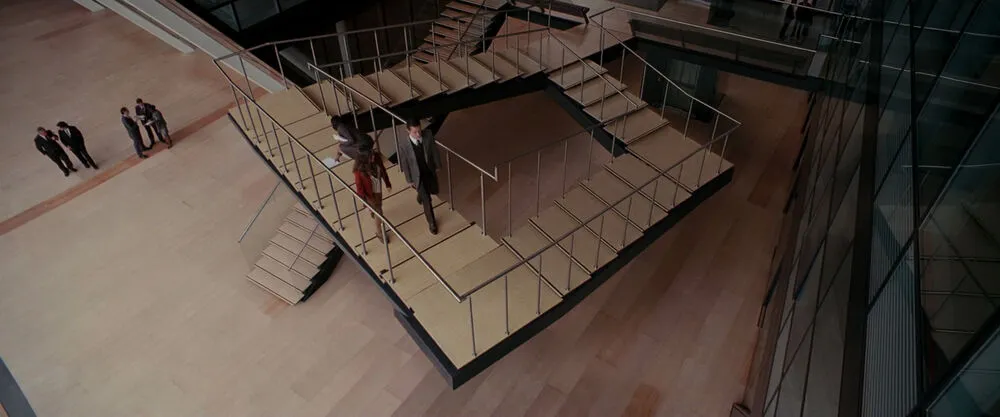
Also noted in last month’s post, here’s a still image related to a scene in the movie “Inception” that had a physical implementation of an impossible (never-ending) staircase; our limited geometric perspectives can deceive us:

Penrose stairs in the movie "Inception"

Since there’s no point in “reinventing the wheel” I’ll quote from Wikipedia’s definition for non-Euclidean geometry, also since I’m a novice in that field, but an admirer of art and imagery inspired by that geometry that stretches our imaginations:

In mathematics, non-Euclidean geometry consists of two geometries based on axioms closely related to those that specify Euclidean geometry. As Euclidean geometry lies at the intersection of metric geometry and affine geometry, non-Euclidean geometry arises by either replacing the parallel postulate with an alternative, or relaxing the metric requirement. In the former case, one obtains hyperbolic geometry and elliptic geometry, the traditional non-Euclidean geometries. When the metric requirement is relaxed, then there are affine planes associated with the planar algebras, which give rise to kinematic geometries that have also been called non-Euclidean geometry.

The principles below (from the next section in the Wikipedia page) reveal how the behavior of parallel and perpendicular lines differs in two common non-Euclidean realms; Hyperbolic Geometry and Elliptic Geometry: with a graphic demonstrating how if we don’t make certain Euclidean assumptions about space (e.g. parallel and perpendicular line behavior) such as the requirement that the sum of the angles of a triangle add up to 180°.

The essential difference between the metric geometries is the nature of parallel lines. Euclid‘s fifth postulate, the parallel postulate, is equivalent to Playfair’s postulate, which states that, within a two-dimensional plane, for any given line l and a point A, which is not on l, there is exactly one line through A that does not intersect l. In hyperbolic geometry, by contrast, there are infinitely many lines through A not intersecting l, while in elliptic geometry, any line through A intersects l.

Another way to describe the differences between these geometries is to consider two straight lines indefinitely extended in a two-dimensional plane that are both perpendicular to a third line (in the same plane):

  • In Euclidean geometry, the lines remain at a constant distance from each other (meaning that a line drawn perpendicular to one line at any point will intersect the other line and the length of the line segment joining the points of intersection remains constant) and are known as parallels.

  • In hyperbolic geometry, they diverge from each other, increasing in distance as one moves further from the points of intersection with the common perpendicular; these lines are often called ultraparallels.

  • In elliptic geometry, the lines converge toward each other and intersect.

Here’s a simple graphic that gives a hint about the fundamentals of these mind-warping geometries that might be akin to warm-up exercises for four-dimensional (and beyond) geometries and polytopes, which we like to explore on this website now and then.

Comparison of geometries: Elliptic, Euclidean, Hyperbolic
By Cmglee – Own work, CC BY-SA 4.0, Link

By Cmglee – Own work, CC BY-SA 4.0, Link

Here’s an example of hyperbolic geometric art:

Rhombitriheptagonal tiling
Rhombitriheptagonal tiling – Parcly Taxel, Public domain, via Wikimedia Commons

Here’s an astronaut’s perspective example of how the sum of the angles of a non-Euclidean triangle can add up to more than 180° on the surface of a spheroid (our beloved planet):

Spherical geometry example: sum of angles exceeds 180 degrees
Spherical geometry example: sum of angles exceeds 180 degrees; Lars H. Rohwedder, Sarregouset https://en.wikipedia.org/wiki/File:Triangles_(spherical_geometry).jpg

For further exploration and many more wonderful and artistic images, I recommend this article “The Use of Non-Euclidean Geometry in Art” on the naiadseye blog …
and this post “Non-Euclidean Geometry Art August 4, 2014″ on “Harrison Hartle’s Art/Music/Theater F200 blog.”

The latter has this excellent TED talk video about “The beautiful math of coral” by Margaret Wertheim (2009); I first learned of this fascinating realm of modeling coral reefs (and many other “hyperbolic geometry” life forms with crochet hooks) from my colleague Libby M. in Oregon at a Geometers meeting about 20 years ago who had made and shared several knitted models inspired by this work:

Margaret Wertheim (in the video above) references the work of Froebel, an educational pioneer featured on this website. Froebel-inspired products are available from RedHen Books and Toys featuring unique, hard-to-find educational materials, toys and books such as Bradford Hansen-Smith’s circle folding videos, books and supplies.

In addition to the other affiliates on the GeometryCode.com website featured in the sidebar on every page that help support this “labor of love” website, please check out Ka Gold Sacred geometry jewelry by artist David Weitzman including wearable geometric art including Flower of Life, Seed of Life, Golden Spiral, Fruit of Life, Vesica Piscis, Star tetrahedron “Merkaba”, Fibonacci Whirling Squares Spiral “Phi”, Metatron’s Cube, Chambered Nautilus, Labyrinth, Torus Tube, Tetractys, Sri Yantra mandala, Tree of Life, and Hexagram (Star of David).

The Wolfram MathWorld page on Non-Euclidean Geometry also has many pertinent links and resources.

The Bridges organization has more related material on the subject of mathematical art.


In case you still need a 2025 calendar, there are 10 months left in the year as of the date of this post, and 2025 calendars are still available – as well as my over-quarter-century-old timeless classic reference book, Sacred Geometry Design Sourcebook – Universal Dimensional Patterns, heavily inspired by Escher, and other geometric luminaries.

Filed Under: 2D Geometries, 3D Geometries, 4D Geometries, Fractal Geometry, Platonic Solids, sacred geometry art, sacred geometry jewelry, sacred geometry news, sacred geometry toys, sacred geometry videos

  • Page 1
  • Page 2
  • Page 3
  • Interim pages omitted …
  • Page 6
  • Go to Next Page »

Primary Sidebar

iMac with LightSOURCE Sacred Geometry screensaver

iMac with GeometryCode screensaver example image

GeometryCode: Featured Products

The Geometry Code: book

Universal Symbolic Mirrors of Natural Laws Within Us; Friendly Reminders of Inclusion to Forgive the Dreamer of Separation

learn more… Available Now!

The Geometry Code: Universal Symbolic Mirrors of Natural Laws Within Us; Friendly Reminders of Inclusion to Forgive the Dreamer of Separation - by Bruce Rawles (front cover artwork)

Buy The Geometry Code book and/or Kindle edition


Sacred Geometry
Design Sourcebook

learn more…


Buy this classic reference book


Sacred Geometry Art:
prints, cards, apparel

learn more…


Dodecahedral Bubble


Buy prints, cards, apparel


Martineau Solar System:
prints, cards, apparel

learn more…


Venus and Mars Per Martineau-cropped thumb


Buy prints, cards, apparel

GeometryCode: Recommendations

(GeometryCode.com Favorites on Amazon.com: books, Kindle, videos, art, software, tools, music, etc. will return here soon!)

Astro-logix - a unique system of glow-in-the-dark hubs and day-glow cylinders to make a phenomenal variety of 2D and 3D geometric models
Bluehost - our GeometryCode.com webhost and domain registrar offers superb customer service, technical expertise and value; tops in every respect!
Sacred geometry Jewelry Sacred geometry jewelry by artist David Weitzman Ka-Gold Related Content: Flower of Life, Seed of Life, Golden Spiral, Fruit of Life, Vesica Piscis, Star tetrahedron "Merkaba", Fibonacci Whirling Squares Spiral "Phi", Metatron's Cube, Chambered Nautilus, Labyrinth, Torus Tube, Tetractys, Sri Yantra mandala, Tree of Life, Hexagram (Star of David).
Fractiles Fractiles - Versatile geometric toys made of magnetic diamond shaped tiles
emWave Desktop Heartmath - Biofeedback using the heart's mathematics of interconnection
SacredGaiametry
Iconnect
Metaforms - chrome, bronze and gold-plated geometric pendants, 3D forms and more
Folding Circles - Books, Videos and Supplies - by Bradford Hansen-Smith
RedHen Books and Toys
Unique, hard-to-find educational materials, toys and books such as Bradford Hansen-Smith's circle folding videos, books and supplies.

ZomeTool Zometool - my favorite 3D creative tool/toy system. I use mine for demos and exploration.
More details on our complete list of affiliates; thanks for supporting us by using these links!

Disclosure: If you use our links to purchase featured products and services, we receive compensation from these companies (at no extra cost to you). We select on the basis of excellent performance and value, and, as much as possible, from our own use and testing. We're independently owned. Opinions expressed here are ours. We appreciate your support by purchasing from these links. The intent of this disclosure is compliance with the FTC's Guides Concerning the Use of Endorsements and Testimonials in Advertising.

Fibonacci Quarterly - Official Publication of the Fibonacci Association (since 1963)

Recent GeometryCode Posts

  • Highlights from the November Post Archives on GeometryCode.com
  • Highlights from the October Post Archives on GeometryCode.com
  • Highlights from the September Post Archives on GeometryCode.com
  • Solar System Geometry (per Martineau) Wall Calendars for 2027
  • Highlights from the August Post Archives on GeometryCode.com

Visit the archive site (authored by the late William Goldstein, a.k.a. Will Gold)
The New Invisible College - A Gateway to the Mystical Tradition of the West

The New Invisible College - Chartres-sacred-geometry.com

(Updated 14Oct2022): I recently had the good fortune to discover a website with some superb content … [Read More...] about The New Invisible College: Will Gold’s Chartres-sacred-geometry.com website


Here’s where you can let us know how we can support you ... and how you can support us! Our virtual “tip jar” accepts a variety of methods of making financial donations; any greatly appreciated! You can use Zelle, Venmo, Wise, PayPal, and a check or money order in US dollars works as well.

Copyright © 1997-2025 · Bruce Rawles · customized by Intent Design Studio · hosted by BlueHost · WordPress

Manage Consent
To provide the best experiences, we use technologies like cookies to store and/or access device information. Consenting to these technologies will allow us to process data such as browsing behavior or unique IDs on this site. Not consenting or withdrawing consent, may adversely affect certain features and functions.
Functional Always active
The technical storage or access is strictly necessary for the legitimate purpose of enabling the use of a specific service explicitly requested by the subscriber or user, or for the sole purpose of carrying out the transmission of a communication over an electronic communications network.
Preferences
The technical storage or access is necessary for the legitimate purpose of storing preferences that are not requested by the subscriber or user.
Statistics
The technical storage or access that is used exclusively for statistical purposes. The technical storage or access that is used exclusively for anonymous statistical purposes. Without a subpoena, voluntary compliance on the part of your Internet Service Provider, or additional records from a third party, information stored or retrieved for this purpose alone cannot usually be used to identify you.
Marketing
The technical storage or access is required to create user profiles to send advertising, or to track the user on a website or across several websites for similar marketing purposes.
  • Manage options
  • Manage services
  • Manage {vendor_count} vendors
  • Read more about these purposes
View preferences
  • {title}
  • {title}
  • {title}