• Skip to secondary menu
  • Skip to main content
  • Skip to primary sidebar

Geometry Code

Sacred Geometry Media Resource Blog

Sacred Geometry Resources, Books, Conversations, Art Prints, Cards, Screensavers, Videos, Patterns, Blog and more
  • Intro
  • Shop
    • Bibliography
    • Gallery
      • Gallery: Martineau Solar System
      • Gallery: Sacred Geometry Animations
    • Sacred Geometry Art Cards
    • Sacred Geometry Art Prints
    • Sacred Geometry Books
      • Sacred Geometry Design Sourcebook (SGDS)
        • SGDS: Free Samples
          • Sacred Geometry Design Sourcebook – sample – (page 101) Circle on Each Dodecagon Edge Fractal
          • Sacred Geometry Design Sourcebook – sample – (page 189) Great Pyramid Fold-up Pattern with Pi and Phi Proportions
          • Sacred Geometry Design Sourcebook – sample – (page 216) Great Dodecahedron Fold-up Pattern
          • Sacred Geometry Design Sourcebook – sample – (page 224) Star Tetrahedron Fold-up Pattern
          • Sacred Geometry Design Sourcebook – bonus page – Kepler’s Solid
        • SGDS: FAQ
        • SGDS: Kudos
        • SGDS: Ordering
        • SGDS: Bookstores
        • SGDS: Printable Order Form
        • Sacred Geometry Design Sourcebook – Paypal Orders
      • Mandalas der Heiligen Geometrie (MDHG) das Universale Design der Natur (SGDS German edition)
      • Book: The Geometry Code: Universal Symbolic Mirrors of Natural Laws Within Us; Friendly Reminders of Inclusion to Forgive the Dreamer of Separation by Bruce Rawles
        • The Geometry Code book: Preface by the Author
        • The Geometry Code: book endorsements
        • Acknowledgments (abridged) for The Geometry Code book
        • Buy The Geometry Code book
        • Table of Contents: The Geometry Code book
    • Sacred Geometry Calendars
    • Sacred Geometry Digital Products
    • Sacred Geometry Screen Savers
      • Sacred Geometry Screen Savers: The Geometry Code – Meditation Tool, ScreenSaver, and eBooklet
        • Praise for The Geometry Code – Meditation Tool, Screen Saver, and eBooklet
      • Sacred Geometry Screen Savers: LightSOURCE screensavers and DVDs
    • Sacred Geometry Toys and Tools
      • Use Zometool to build models from SGDS
    • Sacred Geometry Video Patterns
      • Video Patterns: Circulars, Triangulars and More
      • Video Patterns: Flower of Life and Rectangulars
      • Video Patterns: Hexagonals
      • Video Patterns: Pentagonals
      • Video Patterns: How to use
    • Sacred Geometry Videos
    • GeometryCode.com Affiliates
  • Resources
    • Blog
    • Bulletins
      • 2015 Bulletins
      • 2014 Bulletins
      • 2013 Bulletins
      • 2012 Bulletins
      • Sacred Geometry email bulletins archives through 2011
  • About
    • Events
      • Annual Sacred Geometry Multimedia Contest – legacy page
    • Contact Us and Recent Visitors
    • Donations and Contributions
    • Support
    • Our Web Sites
    • Sacred Geometry – Consulting Services
    • Link To Us
    • Media Kit – Elysian Publishing and Bruce Rawles
    • Sacred Geometry Glossary
    • Copyright Information
    • Disclaimer
  • Free
    • Platonic Solids – Fold Up Patterns
    • Archimedean Solids – Fold Up Patterns
    • Polyhedra: Illustrations of Platonic And Archimedean Solids
    • Polyhedra: Math Tables for Platonic And Archimedean Solids
    • How to graphically derive the Golden Ratio using an equilateral triangle inscribed in a circle
    • How to calculate the area of the Vesica Piscis
    • Rotating Star Tetrahedra, Polyhedra – Animations and Ray Traced Images
    • How to graphically make the “Seed of Life” pattern using a compass
    • How to graphically divide a line by the Golden Ratio using a straightedge and compass
    • Sacred Geometry Bookmarks – Pentagonal Spirals
    • Sacred Geometry Wallpaper (desktop image) – Venus and Mars per Martineau
  • Contact Us/Subscribe
  • Site Map
You are here: Home / Archives for 3D Geometries

3D Geometries

Iridescent Platonic Solids: a quick AI generation experiment

Saturday, 1 November 2025 by Bruce Rawles

I just tried a quick experiment with ChatGPT to see what it would generate with the prompts below. When we visited Oaxaca, Mexico, a decade or two ago, we were inspired by the colorful carved and painted “alebrijes”. We brought home a few souvenirs, so I started with this whimsical idea. The response was great in terms of making colorful animal figurines – they look like they might be illuminated with ultraviolet light … but the only animal that could slightly be considered to be even partially constructed from a Platonic solid was the hindquarters of the bull:

ChatGPT experiment: rainbow colored alebrijes

Then I tried eliminating the animal element but adding iridescence; the iridescent quality of the polygon surfaces was superb in this regard, just the quality I was envisioning. However, I wanted the 5 Platonic Solids, and the AI query got 4 out of 5 right, with the icosahedron duplicated (lower center and lower right) and the octahedron replaced with what looks like a hexagonal bipyramid in the upper right of the 6 polyhedra.

ChatGPT experiment: platonic solids with iridescent gradient faces; icosahedron replaced with hexagonal bipyramid

I gave it another go, and the iridescence mostly went away (although still nice rainbow gradient surfaces, now with black edges), and the bipyramid corrected to an octahedron.

ChatGPT experiment: platonic solids with rainbow gradient faces; icosahedron duplicated

I think I might dust off MegaPOV (or whatever might be a good ray-tracing app for the Macintosh) and see if I can get an AI app to generate the code needed as input to a more conventional ray-tracing app to see if I can coax a bit more mathematical precision.

Any suggestions, anyone?


Filed Under: 3D Geometries, AI-generated geometric art, Platonic Solids, sacred geometry apps, sacred geometry art, sacred geometry toys

AI Geometric Art Tools

Sunday, 24 August 2025 by Bruce Rawles

This post will pose more questions than answers, since it seems we’re still in the “wild west” early days of popular adoption of a plethora of AI offerings, and I am hardly keeping up with all the developments in so many sectors as “everyone and their uncle” jumps on the proverbial AI bandwagon!

(I’m also in the midst of moving from Arizona back to Oregon, so this will be a quick commentary! I hope to have much more useful information, helpful resources, and examples in a future post!)

In prior posts, I’ve dabbled with some AI-generated geometric imagery:

  • Digital dabbling with Dall-E (early primitive experiments)
  • AI generated geometry – revisited a few months later (a little further along, but still nascent)

Here is an example from the more recent post:

Dall-E 3 AI-generated image using prompt "make an image of (a) sea of mirrored geodesic spheres" thanks to Dave Van Dyke

Here is an example from the earlier post:

While the geometric imagery generated by artificial intelligence is often stunning, I typically notice that the images frequently don’t provide accurate models of precise geometric archetypes, being more oriented toward popular art and illustration than images for science, engineering, or renderings with CAD accuracy. If one looks closely, there are inconsistencies and “wonkiness” that don’t hold up to zoomed-in scrutiny if one wants the photorealism that ray-tracing software can achieve.

Do you know of websites, software, AI apps running on various platforms, browsers, devices, etc., that address this seeming void in AI functionality? I’m hoping that soon we’ll find mechanisms that assist in generating imagery with the same accuracy as ray-tracing software using precise geometric coordinates for the vertices of polyhedra, for example. If so, let me know via our contact form.

I found this web page of “AI Geometric Art Examples” by Open Art that looks promising, but when I click on the “… create …” buttons, I arrive at a more generic-looking interface. I’ll explore further when I have more time, but I’m eager to hear from readers if you’ve found good AI for geometry. Here’s a nice image from the page noted above:

AI Geometric Art Example by OpenArt

I posed this query: “geometric image generation for science, engineering, renderings with CAD precision” to my browser (Brave) and got this response:

“Geometric Image Generation for Science
Recent advancements in geometric image generation for science, engineering, and high-precision renderings are increasingly focused on bridging the gap between visual data and parametric Computer-Aided Design (CAD) models. A significant development is the CADCrafter framework, which generates parametric CAD models directly from unconstrained real-world images, such as those captured by users with standard cameras.
This approach leverages a latent diffusion model conditioned on geometric features like depth and normal maps, which are invariant to texture and help mitigate the domain gap between synthetic training data and real-world images.
To ensure the generated CAD command sequences are geometrically valid, the model employs direct preference optimization (DPO) fine-tuning using feedback from an automatic CAD compiler, which acts as a code checker to categorize outputs as valid or invalid.

This method addresses the limitations of traditional generative models that produce 3D shapes with rough surfaces and indistinct edges, which lack the precision required for manufacturing and simulation.
By training solely on synthetic textureless CAD data and testing on real-world images, CADCrafter demonstrates robustness and generalization to unseen objects, even when processing single-view images.
The framework’s ability to distill knowledge from multi-view to single-view inputs enhances its accuracy and practicality for everyday applications.

Further, geometric deep learning (GDL) techniques are being applied to analyze and generate CAD data directly from complex representations like Boundary Representation (B-Rep), which encodes high-level parametric details.
GDL methods, including Graph Neural Networks (GNNs) and Transformers, are used for tasks such as similarity analysis, retrieval, synthesis, and autocompletion of CAD models, aiming to automate repetitive design tasks and facilitate design reuse.
These methods can learn intricate geometric features from B-Rep data without converting it to formats like meshes or point clouds, thus avoiding computational expense and information loss.

For applications involving imaging data, such as microtomographic scans, fast, realistic simulations on GPUs are used to generate synthetic CT images that include realistic artefacts like beam hardening and photon noise.
These simulations are crucial for creating accurate CAD models from data affected by strong imaging artefacts, enabling precise geometric analysis of materials and structures.
The gVirtualXray (gVXR) framework exemplifies this, simulating X-ray projections and CT volumes in milliseconds on a GPU, which is orders of magnitude faster than Monte Carlo simulations, while maintaining high accuracy.
This speed enables the use of repetitive simulations for tasks like image registration and training deep-learning algorithms.

These integrated approaches—combining image-to-CAD generation, geometric deep learning, and high-fidelity simulation—represent a transformative shift towards creating precise, editable, and manufacturable digital twins from diverse data sources, significantly enhancing workflows in science, engineering, and design.

AI-generated answer. Please verify critical facts.”

(Note the now familiar disclaimer in the last line.)


Do you have suggestions for future GeometryCode.com blog posts? Please let us know; we just updated and simplified our ongoing survey here.

Filed Under: 2D Geometries, 3D Geometries, AI-generated geometric art, applications, polyhedra, sacred geometry apps, sacred geometry news

Details about contents of Sacred Geometry Design Sourcebook and instructions for creating the graphics therein

Saturday, 19 July 2025 by Bruce Rawles

I’m glad I reviewed some of my oldest posts, as this post (originally published January 30, 2007) needed resurrecting and updating! I will leave the details from 18 years ago mostly intact, so if you want to dive in, scroll down to the “HOW-TO” INFO STARTS HERE heading for lots of “how to” info on many of the pages to make optimum use of my first book, Sacred Geometry Design Sourcebook!


Here’s another post from my blog archives that details the contents of specific pages of my Sacred Geometry Design Sourcebook, as well as instructions on how to replicate many of the images in the book.

30Jan2007 09:17 AM Filed in: Geometry-Math
Today’s post is an email conversation I had with a visitor to the intent.com website – our first website, which has changed hands several times since the 1990s! – that I probably could have written a decade ago, so this might be useful to those of you who already have purchased a copy of the book (and thanks to all of you who have supported me in this way over the years!) There are a few other goodies on my site map that might also be of interest.

Hi Julian:

Many thanks for your inquiry. I got so involved with the reply that I’ve decided to post it on my blog for today, as well as in this email; I’m grateful that you asked the question, so now I can answer it for the world.

On 30 Jan 2007, at 6:54 AM, Julian wrote:

Dear Bruce:

I was reading your web pages about your book SACRED GEOMETRY DESIGN SOURCEBOOK, and I wondered if you could tell me whether the book provides the reader with details of how to draw the 2-D patterns for themselves or whether they are just templates without such instruction.

The simplest answer is “yes and no”, depending on which of the 1300+ images you’re referring to.


The detailed answer is – here goes! – that I cover some of the philosophy and underlying math, concepts, and archetypal ideas at the beginning of the book, and provide a
generous assortment of references in the back of the book. For the remainder (majority of the 256 pages), I give the images as much room as possible so that not only can the patterns be photocopied easily (I went with spiral binding just for that reason), so that the image quality would be as high as possible for an 8.5″ by 11″ format.

“HOW-TO” INFO STARTS HERE:

Some of the illustrations give step-by-step procedures (in graphical form, assuming some basic familiarity with how to use a compass and straightedge, such as:

page 44 (showing how “unit cells” for the tiling patterns can be used to create an enormously expanded variety of additional patterns by recognizing how the space-filling shapes can be varied; this applies to the “unit cell” examples on pages 16-43,

page 45 (showing how each of the patterns on pages 16-43 can be embellished with fractal or other inscribed detail for each of the polygons for an infinite (literally!) variety of possible variations, which also apply to the majority of the remaining images in the book; page 237 gives a 3D example of this),

pages 46-84 have either explicit (most of these pages) or simple to observe implicit “unit cells” which show how these can be created in a great variety of ways,

page 84 (Pentagon Rotation Grid) gives the 73.2% proportion crucial to the exact construction of this pattern,

page 85 (Genesis of the Seed of Life) shows the step-by-step “compass only” construction of this important and universal pattern,

page 86-95 (variations on Seed of Life and Flower of Life) show how once the Seed of Life is constructed, many other patterns can be easily derived – Flower of Life, Hexagonal Grid, 2nd Harmonic Overlay which is used in Mika Feinberg’s beautiful LightSOURCE screensaver animation (no longer available); see my links (resources) page, Tree of Life, Fruit of Life, Heart and Ankh matrices, recursions, Metatron’s Cube, etc.,

page 95: since the Dodecahedron is the most complicated shape to derive from Metatron’s cube, the top center illustration on this page shows which vertices are used to create the “dodecahedron 2D shadow” with small circles highlighted in the larger image,

page 96: The general instructions for creating Nested Inscribed Polygons appear on this page,

pages 100-101-102: other examples of the crucial proportions needed to create these images either by hand or with a computer graphics program; numerous pages provide these instructions in the text without detracting from the space given to the images,

pages 104-105, 110-113, 123-124, 128, 130, 138-139, 144-145, 155, 163, 166, 171, 176-180, 182-187: all have instructions and details on how to create the images,

page 146: very detailed step-by-step instructions for inscribing a pentagon within a circle,

page 147: very detailed step-by-step instructions for inscribing a pentagon starting from one side of a given length,

page 156: very detailed step-by-step instructions for creating a golden rectangle (including “whirling squares and more),

page 156: very detailed step-by-step instructions for dividing a line by the golden ratio,

page 157: very detailed mathematical information about golden ratio progressions and powers, illustrated graphically,

page 188: shows how the Parthenon at the Acropolis in Athens, Greece, incorporates the golden ratio,

page 189: an amazing amount of data on this page about the Great Pyramid at Giza, Egypt showing phi (golden ratio) and pi proportions, and the proportions of the so-called “King’s Chamber” although the so-called “sarcophagus” (granite box) within is too large to fit through the only passage leading into that chamber, which violates the generally accepted funerary rite theory,

page 190: the classic “Measure of Man” (Vitruvian Man) by Leonardo daVinci, copied around the world, showing the golden ratio proportions in the human body,

page 191: the only known CAD drawing adaptation (to my knowledge) of Leonardo’s “Ideal Church” sketch,

page 192: detailed specifics about the Shoemaker’s Knife of Archimedes, giving several variations all showing the mathematical principle,

page 194: details of the geometry of the classic 1991 Barbury Castle, England crop circle formation,

page 195 and page 52: the details of the geometry encoded in the Sri Yantra (a classic Hindu mandala) and the cross section of the Great Pyramid at Giza, Egypt (also the “squaring the circle” conundrum), both with a 1-Phi-Square Root of Phi triangle which has a 51 degree, 51 minute slope,

page 196: numerous details common to the 5 Platonic and 13 Archimedean Solids,

pages 197-214; numerous details specific to the 5 Platonic and 13 Archimedean Solids, including how the insphere/intersphere/circumsphere/side length proportions are calculated,

pages 215-224: similar details specific to the 4 Kepler-Poinsot solids, the Star Tetrahedron (a.k.a. Stella Octangula) and related polyhedra,

pages 225-229: numerous graphics showing how the Platonic Solids relate to each other in a myriad of fascinating (awe-inspiring, really!) ways,

pages 230-235: numerous relationships between 3D polyhedra with 5-sided symmetry and the “shadow” they cast on a decagon (10-sided polygon), with construction details,

page 236: step-by-step instructions on creating an accurate drawing of the Icosahedron and Dodecahedron starting from a Golden Rectangle,

pages 237-255: generous appendices for hands-on explorers of all ages and levels of experience, including tables and charts of regular polygon angles, apothem, radius and side ratios and areas, radius ratios by coordination number for Ionic Chemical Bonding (which relates to properties of materials at the molecular and planetary levels), Fibonacci Numbers, Perfect Right Triangles (when I put the book together, I wasn’t aware of the Phi-1/Phi-Square Root of 3 Right Triangle that Mike Green of British Columbia introduced me to), Prime Numbers, extensive tables with all sorts of data on the Platonic and Archimedean Solids (useful for a variety of purposes, including model construction and computer simulation and animation, a map of planet Earth showing superimposed Platonic Solid Vertex Latitudes and (example) Longitudes, a fun stereogram with 6 Small Stellated Dodecahedra (there, I gave the clue  a short bio of myself, 3 pages of bibliography (more on my books and links pages and blog), and unique graphical index to all the illustrations in the book. Whew! I’d almost forgotten how much I packed into this labor of love over a decade ago!

Many of the 1300+ images are somewhat self-explanatory graphically (especially if you have created the basic shapes like the Seed of Life, Golden Rectangle, and a few others by hand with compass and straight-edge, which I highly recommend for anyone, as mentor Keith Critchlow so aptly reminded me when reviewing my original manuscript)…

… and of course, if you find re-creating one of the patterns challenging, I’d be happy to answer other questions via email so that I can share with other enthusiasts; thanks for asking!

Filed Under: 2D Geometries, 3D Geometries, Fractal Geometry, sacred geometry art, sacred geometry books

Encyclopedia of Polyhedra By George W. Hart … and other geometric gems

Sunday, 16 March 2025 by Bruce Rawles

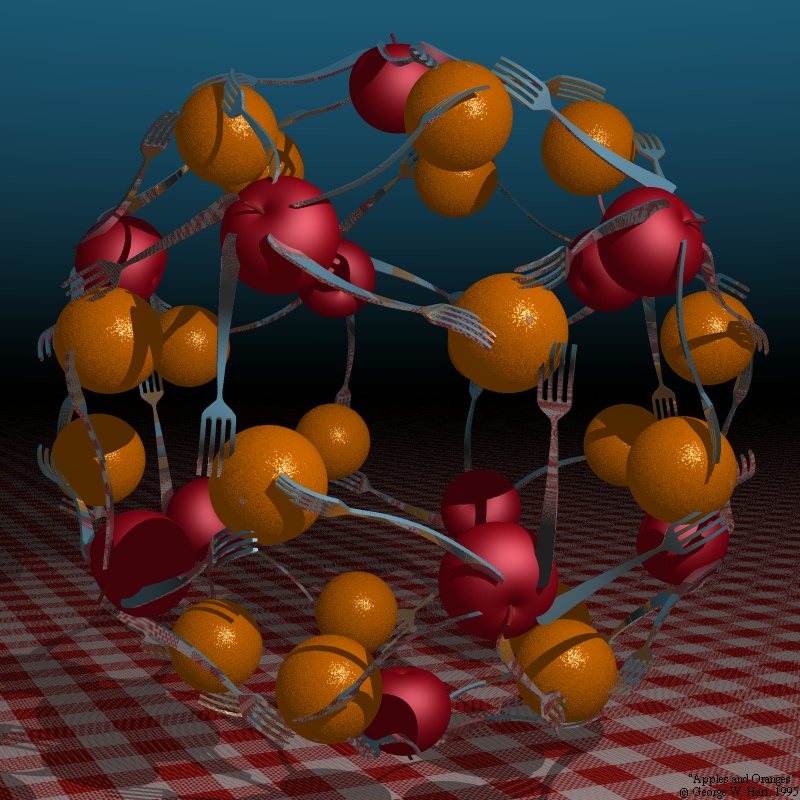
Apples and Oranges by George W. Hart https://www.georgehart.com/Applorng.html
Apples and Oranges by George W. Hart
https://www.georgehart.com/Applorng.html

It’s time to revisit the work of other polyhedra enthusiasts. Of particular note (having crossed my digital path again recently) is George W. Hart who has shared some excellent resources along these lines (faces, vertices, etc.) for decades. Here’s one gold mine to explore: Virtual Polyhedra: The Encyclopedia of Polyhedra By George W. Hart. Here is part of the table of contents and highly recommended if you want to explore the genres and categories of polyhedra; lots of great imagery, rotatable 3D models (rotate them with your mouse), facts and details:

  • Platonic Solids (Regular Convex Polyhedra) Background List of models
  • Kepler-Poinsot Polyhedra (Regular NonConvex Polyhedra)Background List of models
  • Archimedean Polyhedra (Semi-Regular Convex Polyhedra) Background List of models
  • Prisms and Anti-Prisms Background List of models
  • Archimedean Duals Background List of models
  • Quasi-Regular Polyhedra Background List of Models
  • Johnson Solids (the remaining convex polyhedra with regular faces) Background List of models
  • Pyramids, Dipyramids, and Trapezohedra Background List of models
  • Compound Polyhedra — Introduction Background List of models
  • Stellated Polyhedra — Introduction Background List of models
  • Compounds of Cubes Background List of models
  • Convex Deltahedra Background List of models
  • Zonohedra Background List of models
  • Uniform Polyhedra Background List of models
  • Uniform Compounds of Uniform Polyhedra Background List of models
  • Stellations of the Icosahedron Background List of models
  • Stellations of the Rhombic Triacontahedron Background List of models

Perhaps the most well-known and ubiquitous polyhedral shapes have fold-up models (and related patterns) for the first 3 categories above in Sacred Geometry Design Sourcebook (SGDS pages 196-220) and also on this website for the 5 Platonic Solids and 13 Archimedean Solids as well as Illustrations of Platonic And Archimedean Solids, Math Tables for Platonic And Archimedean Solids (and much more about polyhedra on this website.

compound of five cubes by George W. Hart

If you exhaust this generous resource (or somehow overlook a few gems) here are more of his contributions – the videos are particularly helpful if you want to replicate his constructions:

  • The Pavilion of Polyhedreality
  • George’s Instagram page with some excellent 3D geometric sculptures
  • Mathematical Impressions: The Golden Ratio (short video)
  • Hyperboloids (short video)
  • Little Zonohedral Library (short video; my favorite of these which also features our mutual friend Russell Towle who showed me his 3D zonohedral models (such as Rhombic Spirallohedra)
    years ago in Dutch Flat, California)
  • Ceci n’est pas une lampe (fun, clever, short video)
  • Birdland (another clever short video)
  • Seven Slide-Together Constructions (another interesting short video)
  • … and MANY more!
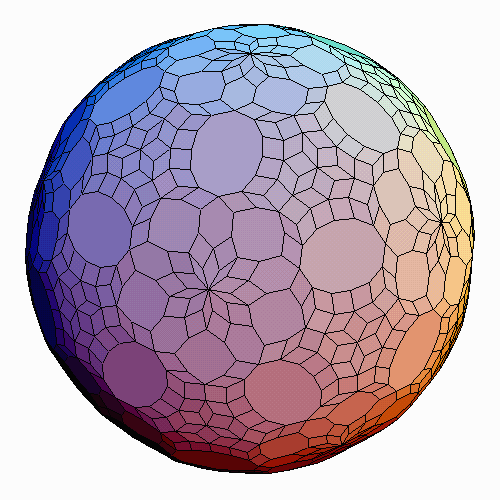
Stained Glass Ball By George W. Hart https://www.georgehart.com/stained_glass.html
Stained Glass Ball By George W. Hart
https://www.georgehart.com/stained_glass.html

Filed Under: 2D Geometries, 3D Geometries, applications, Archimedean Solids, golden ratio, Platonic Solids, polyhedra, sacred geometry art

Non-Euclidean Geometries

Sunday, 23 February 2025 by Bruce Rawles

At the end of last month’s post we gave this example of non-Euclidean geometric art inspired by M. C. Escher’s pioneering graphics which explored various geometries and illusory perspectives.

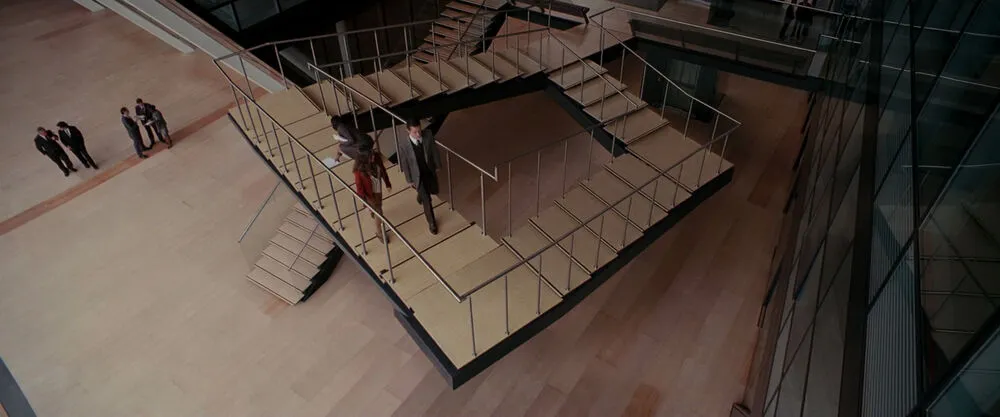
Also noted in last month’s post, here’s a still image related to a scene in the movie “Inception” that had a physical implementation of an impossible (never-ending) staircase; our limited geometric perspectives can deceive us:

Penrose stairs in the movie "Inception"

Since there’s no point in “reinventing the wheel” I’ll quote from Wikipedia’s definition for non-Euclidean geometry, also since I’m a novice in that field, but an admirer of art and imagery inspired by that geometry that stretches our imaginations:

In mathematics, non-Euclidean geometry consists of two geometries based on axioms closely related to those that specify Euclidean geometry. As Euclidean geometry lies at the intersection of metric geometry and affine geometry, non-Euclidean geometry arises by either replacing the parallel postulate with an alternative, or relaxing the metric requirement. In the former case, one obtains hyperbolic geometry and elliptic geometry, the traditional non-Euclidean geometries. When the metric requirement is relaxed, then there are affine planes associated with the planar algebras, which give rise to kinematic geometries that have also been called non-Euclidean geometry.

The principles below (from the next section in the Wikipedia page) reveal how the behavior of parallel and perpendicular lines differs in two common non-Euclidean realms; Hyperbolic Geometry and Elliptic Geometry: with a graphic demonstrating how if we don’t make certain Euclidean assumptions about space (e.g. parallel and perpendicular line behavior) such as the requirement that the sum of the angles of a triangle add up to 180°.

The essential difference between the metric geometries is the nature of parallel lines. Euclid‘s fifth postulate, the parallel postulate, is equivalent to Playfair’s postulate, which states that, within a two-dimensional plane, for any given line l and a point A, which is not on l, there is exactly one line through A that does not intersect l. In hyperbolic geometry, by contrast, there are infinitely many lines through A not intersecting l, while in elliptic geometry, any line through A intersects l.

Another way to describe the differences between these geometries is to consider two straight lines indefinitely extended in a two-dimensional plane that are both perpendicular to a third line (in the same plane):

  • In Euclidean geometry, the lines remain at a constant distance from each other (meaning that a line drawn perpendicular to one line at any point will intersect the other line and the length of the line segment joining the points of intersection remains constant) and are known as parallels.

  • In hyperbolic geometry, they diverge from each other, increasing in distance as one moves further from the points of intersection with the common perpendicular; these lines are often called ultraparallels.

  • In elliptic geometry, the lines converge toward each other and intersect.

Here’s a simple graphic that gives a hint about the fundamentals of these mind-warping geometries that might be akin to warm-up exercises for four-dimensional (and beyond) geometries and polytopes, which we like to explore on this website now and then.

Comparison of geometries: Elliptic, Euclidean, Hyperbolic
By Cmglee – Own work, CC BY-SA 4.0, Link

By Cmglee – Own work, CC BY-SA 4.0, Link

Here’s an example of hyperbolic geometric art:

Rhombitriheptagonal tiling
Rhombitriheptagonal tiling – Parcly Taxel, Public domain, via Wikimedia Commons

Here’s an astronaut’s perspective example of how the sum of the angles of a non-Euclidean triangle can add up to more than 180° on the surface of a spheroid (our beloved planet):

Spherical geometry example: sum of angles exceeds 180 degrees
Spherical geometry example: sum of angles exceeds 180 degrees; Lars H. Rohwedder, Sarregouset https://en.wikipedia.org/wiki/File:Triangles_(spherical_geometry).jpg

For further exploration and many more wonderful and artistic images, I recommend this article “The Use of Non-Euclidean Geometry in Art” on the naiadseye blog …
and this post “Non-Euclidean Geometry Art August 4, 2014″ on “Harrison Hartle’s Art/Music/Theater F200 blog.”

The latter has this excellent TED talk video about “The beautiful math of coral” by Margaret Wertheim (2009); I first learned of this fascinating realm of modeling coral reefs (and many other “hyperbolic geometry” life forms with crochet hooks) from my colleague Libby M. in Oregon at a Geometers meeting about 20 years ago who had made and shared several knitted models inspired by this work:

Margaret Wertheim (in the video above) references the work of Froebel, an educational pioneer featured on this website. Froebel-inspired products are available from RedHen Books and Toys featuring unique, hard-to-find educational materials, toys and books such as Bradford Hansen-Smith’s circle folding videos, books and supplies.

In addition to the other affiliates on the GeometryCode.com website featured in the sidebar on every page that help support this “labor of love” website, please check out Ka Gold Sacred geometry jewelry by artist David Weitzman including wearable geometric art including Flower of Life, Seed of Life, Golden Spiral, Fruit of Life, Vesica Piscis, Star tetrahedron “Merkaba”, Fibonacci Whirling Squares Spiral “Phi”, Metatron’s Cube, Chambered Nautilus, Labyrinth, Torus Tube, Tetractys, Sri Yantra mandala, Tree of Life, and Hexagram (Star of David).

The Wolfram MathWorld page on Non-Euclidean Geometry also has many pertinent links and resources.

The Bridges organization has more related material on the subject of mathematical art.


In case you still need a 2025 calendar, there are 10 months left in the year as of the date of this post, and 2025 calendars are still available – as well as my over-quarter-century-old timeless classic reference book, Sacred Geometry Design Sourcebook – Universal Dimensional Patterns, heavily inspired by Escher, and other geometric luminaries.

Filed Under: 2D Geometries, 3D Geometries, 4D Geometries, Fractal Geometry, Platonic Solids, sacred geometry art, sacred geometry jewelry, sacred geometry news, sacred geometry toys, sacred geometry videos

  • « Go to Previous Page
  • Page 1
  • Page 2
  • Page 3
  • Page 4
  • Page 5
  • Page 6
  • Interim pages omitted …
  • Page 34
  • Go to Next Page »

Primary Sidebar

iMac with LightSOURCE Sacred Geometry screensaver

iMac with GeometryCode screensaver example image

GeometryCode: Featured Products

The Geometry Code: book

Universal Symbolic Mirrors of Natural Laws Within Us; Friendly Reminders of Inclusion to Forgive the Dreamer of Separation

learn more… Available Now!

The Geometry Code: Universal Symbolic Mirrors of Natural Laws Within Us; Friendly Reminders of Inclusion to Forgive the Dreamer of Separation - by Bruce Rawles (front cover artwork)

Buy The Geometry Code book and/or Kindle edition


Sacred Geometry
Design Sourcebook

learn more…


Buy this classic reference book


Sacred Geometry Art:
prints, cards, apparel

learn more…


Dodecahedral Bubble


Buy prints, cards, apparel


Martineau Solar System:
prints, cards, apparel

learn more…


Venus and Mars Per Martineau-cropped thumb


Buy prints, cards, apparel

GeometryCode: Recommendations

(GeometryCode.com Favorites on Amazon.com: books, Kindle, videos, art, software, tools, music, etc. will return here soon!)

Astro-logix - a unique system of glow-in-the-dark hubs and day-glow cylinders to make a phenomenal variety of 2D and 3D geometric models
Bluehost - our GeometryCode.com webhost and domain registrar offers superb customer service, technical expertise and value; tops in every respect!
Sacred geometry Jewelry Sacred geometry jewelry by artist David Weitzman Ka-Gold Related Content: Flower of Life, Seed of Life, Golden Spiral, Fruit of Life, Vesica Piscis, Star tetrahedron "Merkaba", Fibonacci Whirling Squares Spiral "Phi", Metatron's Cube, Chambered Nautilus, Labyrinth, Torus Tube, Tetractys, Sri Yantra mandala, Tree of Life, Hexagram (Star of David).
Fractiles Fractiles - Versatile geometric toys made of magnetic diamond shaped tiles
emWave Desktop Heartmath - Biofeedback using the heart's mathematics of interconnection
SacredGaiametry
Iconnect
Metaforms - chrome, bronze and gold-plated geometric pendants, 3D forms and more
Folding Circles - Books, Videos and Supplies - by Bradford Hansen-Smith
RedHen Books and Toys
Unique, hard-to-find educational materials, toys and books such as Bradford Hansen-Smith's circle folding videos, books and supplies.

ZomeTool Zometool - my favorite 3D creative tool/toy system. I use mine for demos and exploration.
More details on our complete list of affiliates; thanks for supporting us by using these links!

Disclosure: If you use our links to purchase featured products and services, we receive compensation from these companies (at no extra cost to you). We select on the basis of excellent performance and value, and, as much as possible, from our own use and testing. We're independently owned. Opinions expressed here are ours. We appreciate your support by purchasing from these links. The intent of this disclosure is compliance with the FTC's Guides Concerning the Use of Endorsements and Testimonials in Advertising.

Fibonacci Quarterly - Official Publication of the Fibonacci Association (since 1963)

Recent GeometryCode Posts

  • Highlights from the November Post Archives on GeometryCode.com
  • Highlights from the October Post Archives on GeometryCode.com
  • Highlights from the September Post Archives on GeometryCode.com
  • Solar System Geometry (per Martineau) Wall Calendars for 2027
  • Highlights from the August Post Archives on GeometryCode.com

Visit the archive site (authored by the late William Goldstein, a.k.a. Will Gold)
The New Invisible College - A Gateway to the Mystical Tradition of the West

The New Invisible College - Chartres-sacred-geometry.com

(Updated 14Oct2022): I recently had the good fortune to discover a website with some superb content … [Read More...] about The New Invisible College: Will Gold’s Chartres-sacred-geometry.com website


Here’s where you can let us know how we can support you ... and how you can support us! Our virtual “tip jar” accepts a variety of methods of making financial donations; any greatly appreciated! You can use Zelle, Venmo, Wise, PayPal, and a check or money order in US dollars works as well.

Copyright © 1997-2025 · Bruce Rawles · customized by Intent Design Studio · hosted by BlueHost · WordPress

Manage Consent
To provide the best experiences, we use technologies like cookies to store and/or access device information. Consenting to these technologies will allow us to process data such as browsing behavior or unique IDs on this site. Not consenting or withdrawing consent, may adversely affect certain features and functions.
Functional Always active
The technical storage or access is strictly necessary for the legitimate purpose of enabling the use of a specific service explicitly requested by the subscriber or user, or for the sole purpose of carrying out the transmission of a communication over an electronic communications network.
Preferences
The technical storage or access is necessary for the legitimate purpose of storing preferences that are not requested by the subscriber or user.
Statistics
The technical storage or access that is used exclusively for statistical purposes. The technical storage or access that is used exclusively for anonymous statistical purposes. Without a subpoena, voluntary compliance on the part of your Internet Service Provider, or additional records from a third party, information stored or retrieved for this purpose alone cannot usually be used to identify you.
Marketing
The technical storage or access is required to create user profiles to send advertising, or to track the user on a website or across several websites for similar marketing purposes.
  • Manage options
  • Manage services
  • Manage {vendor_count} vendors
  • Read more about these purposes
View preferences
  • {title}
  • {title}
  • {title}