I’m giving a day-long, hands-on* sacred geometry workshop from 10AM-5PM on Saturday, October 8, 2011, here at our new home in Castle Rock, Colorado. We’re about 20-60 minutes south of Denver, depending on what part of the metropolitan area you might be driving from. Cost is on a sliding scale from $25-$75 based on need. Pre-registration is required, due to limited space around our dining room table! :-) Please contact Bruce via GeometryCode.com to register. I’ll be happy to phone or Skype with even more details. Please bring a geometer’s compass, straight-edge, scissors and cellophane tape; I will supply lots of 2D and 3D handouts including platonic solid fold-up patterns, plus LOTS of visual multimedia imagery, animation and more, along with plenty of theory on the mystical underpinnings of sacred geometry! :-) I typically bring most of my extensive library on the subject out for everyone to peruse; you can see most of them (except some of the rare and obscure titles) on the GeometryCode Amazon aStore. Here is a full resolution printable flyer for the event.
Platonic Solids
Infinite Recursive Zoom In of Nested Platonic Solids
Infinite Nested Platonic Solid Recursion
This continuous loop rotates around a nest of the five Platonic Solids: Cube (red), Tetrahedron (yellow), Octahedron (green), Icosahedron (blue), and Dodecahedron (purple), returning to a cube oriented along the same x-y-z axes one third the size in each dimension as the outer cube. The transparency of the inner cube changes from 100% opaque to 100% transparent as the animation proceeds, which allows playing as an infinite recursive loop. Each “new cube” (as one loop of the animation completes) has 1/27th the volume of the original, since the side length is 1/3 of the starting cube.
This is a higher resolution version of the clip originally uploaded to YouTube on March 31, 2007.

Zometool Inspiration
 Carlos Neumann with a Zometool ‘microdo’ model
Recently we had lunch in Denver, Colorado with Carlos Neumann of Zometool, the maker of my favorite geometric modeling tool/toy. It’s really both a fabulous design and 3D visualization modeling environment AND a fun toy for any age – even those who don’t think they like geometry. He brought along a Zometool model of the “Microdo.” See the close up photograph below:
 Zometool “microdo” model
and a screen snap of it using the new Zomepad software, a VERY cool 3D modeling app that lets one rotate, modify, translate, zoom, etc. Zometool models in real time. The screen snaps just give a hint of how fun this app is!
 Zomepad image of Microdo model
Here’s a chrome plated (dare we say “Chrome Zome”? :-) hub. Notice that the polygons that make up the hub are equilateral triangles, regular pentagons and golden rectangles, which provide phenomenal versatility in creating Platonic and Archimedean Solids, as well as a staggering array of amazing shapes that use these foundational geometries and their 3-fold and 5-fold rotational symmetries and much more. Stay tuned for fun and decorative developments with these shiny orb-like gems! :-)
 Chrome plated Zometool hub
Another thing to notice about the Zomepad models is that there are background dots: red (pentagonal), yellow (triangular) and blue (golden rectangular) that are aligned behind the model as it rotates around so that you can see when you’re lined up with an axis of rotation and/or symmetry. Pretty neat!
Here are the default models that you can explore with the current pre-release version of the ZomePad app:

 ZomePad 2D hexagonal crystal model
 ZomePad Hypercube (Tesseract) – 3D ‘shadow’ of a 4D polytope
 ZomePad 3D Hexagonal (honey comb) grid model

Here are some Zometool models I put together years ago:
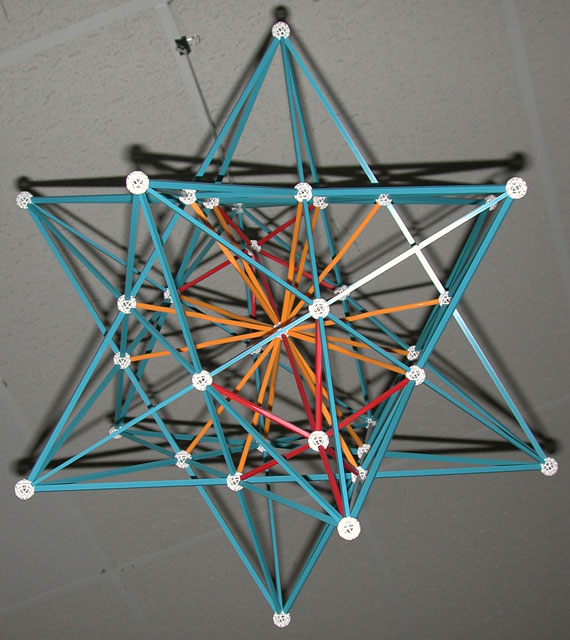
The stellated dodecahedron model hung above my office cubicle at Grass Valley Group in northern California for several years; sure made a great landmark to direct folks to my desk! :-)
Here’s another of the countless topologies and geometric variations that one can make with Zometool hubs and struts. If you enjoyed Tinkertoys (or perhaps Erector sets, etc.) when you were a kid, check out Zometool. There really isn’t anything else like it. The engineering and precision design of the hub alone is an amazing story in itself that Marc Pelletier gave us a quick tour of when I was at a sacred geometry conference in Boulder, Colorado years ago, where I met lots of wonderful geometer colleagues I’m still mostly in touch with.
 Zometool model (one of countless variations to explore)
Dodecahedra Origami Luminaria

After seeing these at a friend’s home recently, I did a google search and found a couple of nice tutorials (Dodecahedron Star Lantern Tutorial from Mom’s Crafty Space and another from WholesomePlayTime.com) for making these Dodecahedron (Pentagram) Star Lanterns; these could also be made using the Dodecahedron foldup pattern, although this design with the 5 folded over triangles on each pentagonal face highlights the inscribed pentagram (5-pointed star) on each face in an artistic way. This is a great kid’s construction project featuring sacred geometry.
Sacred Geometry Communities
The Geometry Code – Sacred Geometry Blog – Conversations – Global Community (this is a blog-ish page from our prior site)
Videos: interviews and more
Here’s a video interview about The Seven Hermetic Laws, Sacred Geometry and more with Alan Steinfeld of New Realities and Bruce Rawles now on YouTube (originally on Emerald Energies) recorded in Sedona, Arizona at the Global Sacred Geometry Conference in Feb 2004. Thanks also to Alan Gutierrez and Angélique DeWolfe for their efforts with this interview.
Here’s a video by Dan Shaw (a long time fellow geometer) of my commentary on the Planetary Geometries: Martineau Solar System Series artwork when it was at the Mobius in Ashland, Oregon during April, 2007.
Audios: interviews and more
This is an audio interview with Jake Steele of Author’s Audio about sacred geometry, the Great Pyramid and more.
Geometric Animations
Here’s an animation I did showing how the Platonic Solids nest perfectly in an infinite recursive 3:1 size scaled loop with each iteration oriented the same – the original video has MUCH better resolution… and the looping is seamless in the QuickTime viewer! There are more details on my blog.)
Local Community (Southern Oregon)
Ashland Geometers – a.k.a. Hedronists
We have a wonderful group of kindred geometers that met somewhat regularly in Ashland, Oregon; we called ourselves by the whimsical name “Hedronists”. We previously had links to our collaborative video/dialogue presence on MySpace, LuminosityWeb, and Ning.
Here’s my individual YouTube site, which had one of our Hedronists meetings in parts 1, 2, 3, 4, 5, and 6.