• Skip to secondary menu
  • Skip to main content
  • Skip to primary sidebar

Geometry Code

Sacred Geometry Media Resource Blog

Sacred Geometry Resources, Books, Conversations, Art Prints, Cards, Screensavers, Videos, Patterns, Blog and more
  • Intro
  • Shop
    • Bibliography
    • Gallery
      • Gallery: Martineau Solar System
      • Gallery: Sacred Geometry Animations
    • Sacred Geometry Art Cards
    • Sacred Geometry Art Prints
    • Sacred Geometry Books
      • Sacred Geometry Design Sourcebook (SGDS)
        • SGDS: Free Samples
          • Sacred Geometry Design Sourcebook – sample – (page 101) Circle on Each Dodecagon Edge Fractal
          • Sacred Geometry Design Sourcebook – sample – (page 189) Great Pyramid Fold-up Pattern with Pi and Phi Proportions
          • Sacred Geometry Design Sourcebook – sample – (page 216) Great Dodecahedron Fold-up Pattern
          • Sacred Geometry Design Sourcebook – sample – (page 224) Star Tetrahedron Fold-up Pattern
          • Sacred Geometry Design Sourcebook – bonus page – Kepler’s Solid
        • SGDS: FAQ
        • SGDS: Kudos
        • SGDS: Ordering
        • SGDS: Bookstores
        • SGDS: Printable Order Form
        • Sacred Geometry Design Sourcebook – Paypal Orders
      • Mandalas der Heiligen Geometrie (MDHG) das Universale Design der Natur (SGDS German edition)
      • Book: The Geometry Code: Universal Symbolic Mirrors of Natural Laws Within Us; Friendly Reminders of Inclusion to Forgive the Dreamer of Separation by Bruce Rawles
        • The Geometry Code book: Preface by the Author
        • The Geometry Code: book endorsements
        • Acknowledgments (abridged) for The Geometry Code book
        • Buy The Geometry Code book
        • Table of Contents: The Geometry Code book
    • Sacred Geometry Calendars
    • Sacred Geometry Digital Products
    • Sacred Geometry Screen Savers
      • Sacred Geometry Screen Savers: The Geometry Code – Meditation Tool, ScreenSaver, and eBooklet
        • Praise for The Geometry Code – Meditation Tool, Screen Saver, and eBooklet
      • Sacred Geometry Screen Savers: LightSOURCE screensavers and DVDs
    • Sacred Geometry Toys and Tools
      • Use Zometool to build models from SGDS
    • Sacred Geometry Video Patterns
      • Video Patterns: Circulars, Triangulars and More
      • Video Patterns: Flower of Life and Rectangulars
      • Video Patterns: Hexagonals
      • Video Patterns: Pentagonals
      • Video Patterns: How to use
    • Sacred Geometry Videos
    • GeometryCode.com Affiliates
  • Resources
    • Blog
    • Bulletins
      • 2015 Bulletins
      • 2014 Bulletins
      • 2013 Bulletins
      • 2012 Bulletins
      • Sacred Geometry email bulletins archives through 2011
  • About
    • Events
      • Annual Sacred Geometry Multimedia Contest – legacy page
    • Contact Us and Recent Visitors
    • Donations and Contributions
    • Support
    • Our Web Sites
    • Sacred Geometry – Consulting Services
    • Link To Us
    • Media Kit – Elysian Publishing and Bruce Rawles
    • Sacred Geometry Glossary
    • Copyright Information
    • Disclaimer
  • Free
    • Platonic Solids – Fold Up Patterns
    • Archimedean Solids – Fold Up Patterns
    • Polyhedra: Illustrations of Platonic And Archimedean Solids
    • Polyhedra: Math Tables for Platonic And Archimedean Solids
    • How to graphically derive the Golden Ratio using an equilateral triangle inscribed in a circle
    • How to calculate the area of the Vesica Piscis
    • Rotating Star Tetrahedra, Polyhedra – Animations and Ray Traced Images
    • How to graphically make the “Seed of Life” pattern using a compass
    • How to graphically divide a line by the Golden Ratio using a straightedge and compass
    • Sacred Geometry Bookmarks – Pentagonal Spirals
    • Sacred Geometry Wallpaper (desktop image) – Venus and Mars per Martineau
  • Contact Us/Subscribe
  • Site Map
You are here: Home / Archives for sacred geometry news

sacred geometry news

Highlights from the February Post Archives on GeometryCode.com

Sunday, 1 February 2026 by Bruce Rawles

Welcome to our curated recap of some of the blog posts published in February across recent years on GeometryCode.com. Each entry below includes the post title, published date, and a graphic image from the post, presented as an enticement for the curious to review prior posts. (This is part 2 of a 12-part series; here are the Highlights from the January Post Archives on GeometryCode.com)

GeometryCode.com — Highlights from February Posts (from 2013 through 2025)

  • New and improved Spirograph
    Published February 2013Spirograph Design Tin Set
  • GeometryCode bulletin for February 2014
    Published February 2014Sacred Geometry Fest 2014 NYC
  • GeometryCode bulletin for February 2015
    Published February 2015
    Blooms-StrobeAnimatedSculptures-Screen Shot 2015-01-31 at 1.07.12 PM
  • Vibration Station Conversation – The Geometry Code Book: Chapter 5: CorrespondenceThe Dance of Venus
    Published February 20162-Correspondence-Symbol for Hermetic Law #2
  • Seed of Life nanotubes, Musical symbolism, Life in a Computer-Simulated Matrix, big geometric lanterns
    Published February 2017Seed Of Life - Nanotubes
  • Reuleaux triangles (and related shapes) revisited – neat video!
    Published February 2018
    Trion-re - Michael R. Evans
  • Quantum Sierpinski Fractals and Dodecahedral Bubbles
    Published February 2019
    dodecahedral bubble
  • Mandelbrot Set: Deep Dive
    Published February 2020Mandelbulb
  • Tetrahedron Volcanic Points on our planet
    Published February 2021Bucky Fuller holding a cuboctahedron
  • The New Invisible College: Will Gold’s Chartres-sacred-geometry.com website
  • Published February 2022

    Interior, Chartres Cathedral
    Interior, Chartres Cathedral
  • Music of the Spheres – The Planets
    Published February 2024
    painting: The School of Athens by Raffaello Sanzio da Urbino
  • Non-Euclidean Geometries
    Published February 2025
    Non-Euclidean Geometry example

Thanks for exploring these highlights from GeometryCode.com’s archives!

In case you missed it, here are the Highlights from the January Post Archives on GeometryCode.com

Filed Under: 2012 Bulletins, 2013 Bulletins, 2014 Bulletins, 2015 Bulletins, 2D Geometries, 3D Geometries, Archimedean Solids, Fibonacci Numbers, Fractal Geometry, golden ratio, Platonic Solids, polyhedra, sacred geometry animation, sacred geometry architecture, sacred geometry art, sacred geometry books, sacred geometry calendars, sacred geometry metaphysics, sacred geometry news, sacred geometry videos

Highlights from the January Post Archives on GeometryCode.com

Thursday, 1 January 2026 by Bruce Rawles

I occasionally encounter ICYMI (In Case You Missed It) anthologies of archives from publications that have been around a while. Since that’s true for GeometryCode.com, I thought I would do the same for this site. I’m sure there are plenty of new (or newish) visitors who have probably never seen many of the prior posts from this website, as well as seasoned readers who may have missed or perhaps forgotten some of the content we’ve featured over the years… since 2009 (and before that for a decade or so on other websites such as our former online home, intent.com. (Thanks to the “Wayback Machine” for maintaining archives of our original, primitive (embarrassing by today’s standards) work in our early web explorations. The format and underlying architecture have changed significantly, but the content of “Sacred Geometry Home Page” hasn’t changed much since this snapshot from Jan. 15, 1998!)

With a bit of clerical assistance from AI, I’m presenting a retrospective (by month, starting with January) of some of the 222 prior posts from GeometryCode that might merit revisiting. However, I will still add new finds as they cross my path, so this quasi-sabbatical won’t be devoid of new content. If you (or someone you know) has something that would enhance this website, please let me know! Thanks for your many years of support while I spend a few months (probably a dozen) re-exploring perennial topics via prior posts with evergreen concepts, ideas, and imagery.

I am using chronological order (rather than the more conventional reverse chronological order), putting recent posts at the bottom to give buried content some breathing room for new or renewed exposure.

Welcome to our curated recap of some of the blog posts published in January across recent years on GeometryCode.com. Each entry below includes the post title, published date, and a graphic image from its content, presented as enticements for the curious to review prior content.

GeometryCode.com — Highlights from January Posts (from 2009 through 2025)

  • Intention and Symbols
    Published January 2009
    Villarceau circles: torus plane intersection yields vesica piscis cross-section
  • QR code for GeometryCode.com
    Published January 2011
    QRcode for www.GeometryCode.com
  • ZomeTool sculpture at Denver Art Museum
    Published January 2012
    ZomeTool-DenverArtMuseum2
  • Sacred Geometry bulletin for January 2013
    Published January 2013
    mirrored pentagon grid
  • Local Author event in Castle Rock, CO 18Jan2014
    Published January 2014
    Local Author Showcase - Castle Rock, CO
  • GeometryCode bulletin for January 2015
    Published January 2015
    7thTermFibonacciGarden-MichaelSchneider
  • The Dance of Venus
    Published January 2016
    The Dance Of Venus poster by John Martineau
  • Multiplication Tables on Circular String Art lead to Mandelbrot and classic curves
    Published January 2017
    Mathologer - String Art Mandelbrot
  • Assorted 3D model geometry links of interest
    Published January 2019
    HexaSticks 3D model
  • 3D Geodesic Animation inspiration
    Published January 2020
  • Geometric Lamps … and Coloring Pages by HYBYCOZO / COZO
    Published January 2022

These last few summaries are courtesy of ChatGPT. Each entry below includes the post title, published date, and a multi-paragraph summary of its content.

  • Cedar Sprig Symbolism: Freedom or Fragmentation?
    Published January 2023

    In this thoughtful January post, Bruce Rawles reflects on participating in a local New Year’s Day Peace Hike in Yachats, Oregon. He uses the symbolism of cedar sprigs as a metaphor for both individual and collective identity. He connects the fractal geometry of the cedar — with its self-similar branching patterns — to how we might view unity and fragmentation in human thought and social life.

    The post weaves imagery from the hike with contemplative commentary on how symbol and form interact: the geometric complexity of cedar sprigs becomes a lens to examine inclusion, peace, and the fractal nature of experience. Rawles draws philosophical connections between natural patterns and inner psychological landscapes, prompting readers to consider whether they view life through lenses of separation or wholeness. This piece blends personal narrative with meditative geometry, exemplifying the blog’s broader mission of uniting mathematical form with lived experience.

  • 2024 Martineau Solar System Calendars Available Now
    Published January 2024 (note that calendars are available again for 2026!)

    This post announces the release of the 2024 Martineau Solar System Geometry wall calendars — a perennial favorite among readers interested in precise geometric representations of planetary orbit relationships. The calendar series is built from ray-traced images that model the intricate spatial relationships among the planets, combining astronomical accuracy with sacred geometry aesthetics. These calendars serve both as functional datekeepers and as contemplative art pieces that invite reflection on the harmony of celestial mechanics.

    Beyond simply promoting the calendar’s availability, the post elaborates on how each month’s artwork is grounded in long-observed geometric patterns linking planetary motion to geometric forms. It draws a line from scientific modeling to artistic expression, inviting readers to contemplate how geometry underlies both the heavens and artistic representation. The narrative suggests that such resources — whether calendars, prints, or patterns — function as mirrors to natural law and can enrich both intellectual and aesthetic appreciation.

    Martineau solar system calendar -12 months

  • M. C. Escher’s Geometry and Illusory Perspectives Revisited
    Published January 2025

    This engaging post reflects on the work of Dutch graphic artist M. C. Escher and the ways that his art embodies rich geometric ideas. The author revisits classic Escher works — including impossible constructions, symmetry patterns, tessellations, and recursive spaces — and ties them into broader themes about how the human mind perceives space and structure. Escher’s art serves as a springboard for discussing how geometry, often thought of as abstract and formal, can be visually vibrant and conceptually playful.

    Throughout the text, readers are encouraged to appreciate how Escher’s imagery not only plays with visual paradoxes but invites a willingness to consider multiple perspectives simultaneously — a theme with deep resonance in non-Euclidean geometry and spatial reasoning. There’s also a conversation about how such visual explorations can inspire geometric creativity and reframe the way we look at patterns, proportion, and dimensionality in both art and mathematics. The author hints that future posts will build on these provocations, particularly around non-Euclidean geometry and related artistic interpretations.

    3 interlocking Escher-inspired reptile tiles

  • Thanks for exploring these highlights from GeometryCode.com’s January archives!

Filed Under: 2012 Bulletins, 2013 Bulletins, 2014 Bulletins, 2015 Bulletins, 2D Geometries, 3D Geometries, coloring books for adults, Fibonacci Numbers, Fractal Geometry, golden ratio, polyhedra, sacred geometry animation, sacred geometry architecture, sacred geometry art, sacred geometry books, sacred geometry calendars, sacred geometry metaphysics, sacred geometry news, sacred geometry toys, sacred geometry videos

AI Geometric Art Tools

Sunday, 24 August 2025 by Bruce Rawles

This post will pose more questions than answers, since it seems we’re still in the “wild west” early days of popular adoption of a plethora of AI offerings, and I am hardly keeping up with all the developments in so many sectors as “everyone and their uncle” jumps on the proverbial AI bandwagon!

(I’m also in the midst of moving from Arizona back to Oregon, so this will be a quick commentary! I hope to have much more useful information, helpful resources, and examples in a future post!)

In prior posts, I’ve dabbled with some AI-generated geometric imagery:

  • Digital dabbling with Dall-E (early primitive experiments)
  • AI generated geometry – revisited a few months later (a little further along, but still nascent)

Here is an example from the more recent post:

Dall-E 3 AI-generated image using prompt "make an image of (a) sea of mirrored geodesic spheres" thanks to Dave Van Dyke

Here is an example from the earlier post:

While the geometric imagery generated by artificial intelligence is often stunning, I typically notice that the images frequently don’t provide accurate models of precise geometric archetypes, being more oriented toward popular art and illustration than images for science, engineering, or renderings with CAD accuracy. If one looks closely, there are inconsistencies and “wonkiness” that don’t hold up to zoomed-in scrutiny if one wants the photorealism that ray-tracing software can achieve.

Do you know of websites, software, AI apps running on various platforms, browsers, devices, etc., that address this seeming void in AI functionality? I’m hoping that soon we’ll find mechanisms that assist in generating imagery with the same accuracy as ray-tracing software using precise geometric coordinates for the vertices of polyhedra, for example. If so, let me know via our contact form.

I found this web page of “AI Geometric Art Examples” by Open Art that looks promising, but when I click on the “… create …” buttons, I arrive at a more generic-looking interface. I’ll explore further when I have more time, but I’m eager to hear from readers if you’ve found good AI for geometry. Here’s a nice image from the page noted above:

AI Geometric Art Example by OpenArt

I posed this query: “geometric image generation for science, engineering, renderings with CAD precision” to my browser (Brave) and got this response:

“Geometric Image Generation for Science
Recent advancements in geometric image generation for science, engineering, and high-precision renderings are increasingly focused on bridging the gap between visual data and parametric Computer-Aided Design (CAD) models. A significant development is the CADCrafter framework, which generates parametric CAD models directly from unconstrained real-world images, such as those captured by users with standard cameras.
This approach leverages a latent diffusion model conditioned on geometric features like depth and normal maps, which are invariant to texture and help mitigate the domain gap between synthetic training data and real-world images.
To ensure the generated CAD command sequences are geometrically valid, the model employs direct preference optimization (DPO) fine-tuning using feedback from an automatic CAD compiler, which acts as a code checker to categorize outputs as valid or invalid.

This method addresses the limitations of traditional generative models that produce 3D shapes with rough surfaces and indistinct edges, which lack the precision required for manufacturing and simulation.
By training solely on synthetic textureless CAD data and testing on real-world images, CADCrafter demonstrates robustness and generalization to unseen objects, even when processing single-view images.
The framework’s ability to distill knowledge from multi-view to single-view inputs enhances its accuracy and practicality for everyday applications.

Further, geometric deep learning (GDL) techniques are being applied to analyze and generate CAD data directly from complex representations like Boundary Representation (B-Rep), which encodes high-level parametric details.
GDL methods, including Graph Neural Networks (GNNs) and Transformers, are used for tasks such as similarity analysis, retrieval, synthesis, and autocompletion of CAD models, aiming to automate repetitive design tasks and facilitate design reuse.
These methods can learn intricate geometric features from B-Rep data without converting it to formats like meshes or point clouds, thus avoiding computational expense and information loss.

For applications involving imaging data, such as microtomographic scans, fast, realistic simulations on GPUs are used to generate synthetic CT images that include realistic artefacts like beam hardening and photon noise.
These simulations are crucial for creating accurate CAD models from data affected by strong imaging artefacts, enabling precise geometric analysis of materials and structures.
The gVirtualXray (gVXR) framework exemplifies this, simulating X-ray projections and CT volumes in milliseconds on a GPU, which is orders of magnitude faster than Monte Carlo simulations, while maintaining high accuracy.
This speed enables the use of repetitive simulations for tasks like image registration and training deep-learning algorithms.

These integrated approaches—combining image-to-CAD generation, geometric deep learning, and high-fidelity simulation—represent a transformative shift towards creating precise, editable, and manufacturable digital twins from diverse data sources, significantly enhancing workflows in science, engineering, and design.

AI-generated answer. Please verify critical facts.”

(Note the now familiar disclaimer in the last line.)


Do you have suggestions for future GeometryCode.com blog posts? Please let us know; we just updated and simplified our ongoing survey here.

Filed Under: 2D Geometries, 3D Geometries, AI-generated geometric art, applications, polyhedra, sacred geometry apps, sacred geometry news

Vandorn Hinnant – 45 Years of Dreaming with Open Eyes – Exhibition Catalogue

Friday, 4 April 2025 by Bruce Rawles

For many years, I’ve admired the geometric art of geometer colleague and artist Vandorn Hinnant; this month’s post features a pdf file of a retrospective of four and a half decades of his geometry-inspired artistry. Enjoy! Be sure to visit his websites LightWeavings.com and VandornHinnant.com for much more info.

Vandorn Hinnant – 45 Years of Dreaming with Open Eyes – Exhibition Catalogue

Download the pdf here.

The Title/Cover page provides the details of the live exhibit which runs from March 20 through June 28, 2025 at the Mary G. Hardin Center for the Cultural Arts, 501 Broad Street, Gadsden, Alabama.

Here are just a few examples of his inspired/inspiring art:

Vandorn Hinnant: "Times Golden Arrow” a.k.a. "Golden Rectangle Mandala” ©2010
Vandorn Hinnant: “Times Golden Arrow” a.k.a. “Golden Rectangle Mandala” ©2010
Vandorn Hinnant: The Truest Eye a.k.a. Root Three Spiraling Fractal Trigons ©1997
Vandorn Hinnant: Ark ©1997
Vandorn Hinnant: Before We Knew - From The MOTHER of Everything ©2002
Vandorn Hinnant: Before We Knew – From The MOTHER of Everything ©2002

Filed Under: 2D Geometries, golden ratio, sacred geometry art, sacred geometry news

Non-Euclidean Geometries

Sunday, 23 February 2025 by Bruce Rawles

At the end of last month’s post we gave this example of non-Euclidean geometric art inspired by M. C. Escher’s pioneering graphics which explored various geometries and illusory perspectives.

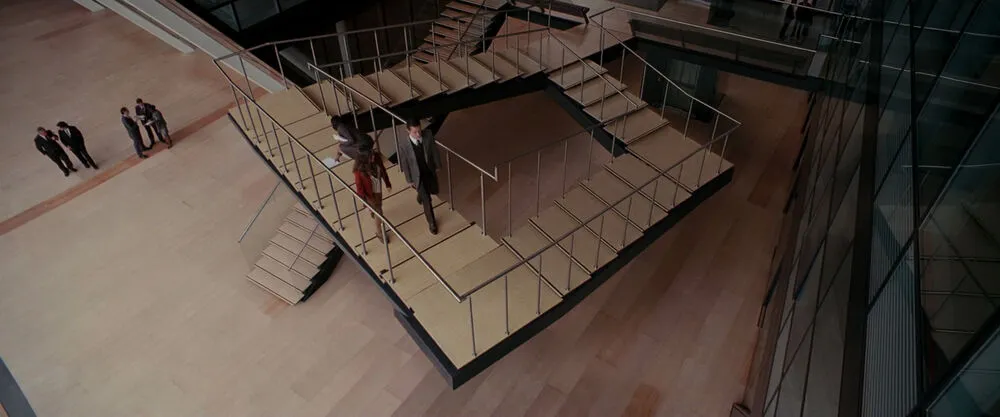
Also noted in last month’s post, here’s a still image related to a scene in the movie “Inception” that had a physical implementation of an impossible (never-ending) staircase; our limited geometric perspectives can deceive us:

Penrose stairs in the movie "Inception"

Since there’s no point in “reinventing the wheel” I’ll quote from Wikipedia’s definition for non-Euclidean geometry, also since I’m a novice in that field, but an admirer of art and imagery inspired by that geometry that stretches our imaginations:

In mathematics, non-Euclidean geometry consists of two geometries based on axioms closely related to those that specify Euclidean geometry. As Euclidean geometry lies at the intersection of metric geometry and affine geometry, non-Euclidean geometry arises by either replacing the parallel postulate with an alternative, or relaxing the metric requirement. In the former case, one obtains hyperbolic geometry and elliptic geometry, the traditional non-Euclidean geometries. When the metric requirement is relaxed, then there are affine planes associated with the planar algebras, which give rise to kinematic geometries that have also been called non-Euclidean geometry.

The principles below (from the next section in the Wikipedia page) reveal how the behavior of parallel and perpendicular lines differs in two common non-Euclidean realms; Hyperbolic Geometry and Elliptic Geometry: with a graphic demonstrating how if we don’t make certain Euclidean assumptions about space (e.g. parallel and perpendicular line behavior) such as the requirement that the sum of the angles of a triangle add up to 180°.

The essential difference between the metric geometries is the nature of parallel lines. Euclid‘s fifth postulate, the parallel postulate, is equivalent to Playfair’s postulate, which states that, within a two-dimensional plane, for any given line l and a point A, which is not on l, there is exactly one line through A that does not intersect l. In hyperbolic geometry, by contrast, there are infinitely many lines through A not intersecting l, while in elliptic geometry, any line through A intersects l.

Another way to describe the differences between these geometries is to consider two straight lines indefinitely extended in a two-dimensional plane that are both perpendicular to a third line (in the same plane):

  • In Euclidean geometry, the lines remain at a constant distance from each other (meaning that a line drawn perpendicular to one line at any point will intersect the other line and the length of the line segment joining the points of intersection remains constant) and are known as parallels.

  • In hyperbolic geometry, they diverge from each other, increasing in distance as one moves further from the points of intersection with the common perpendicular; these lines are often called ultraparallels.

  • In elliptic geometry, the lines converge toward each other and intersect.

Here’s a simple graphic that gives a hint about the fundamentals of these mind-warping geometries that might be akin to warm-up exercises for four-dimensional (and beyond) geometries and polytopes, which we like to explore on this website now and then.

Comparison of geometries: Elliptic, Euclidean, Hyperbolic
By Cmglee – Own work, CC BY-SA 4.0, Link

By Cmglee – Own work, CC BY-SA 4.0, Link

Here’s an example of hyperbolic geometric art:

Rhombitriheptagonal tiling
Rhombitriheptagonal tiling – Parcly Taxel, Public domain, via Wikimedia Commons

Here’s an astronaut’s perspective example of how the sum of the angles of a non-Euclidean triangle can add up to more than 180° on the surface of a spheroid (our beloved planet):

Spherical geometry example: sum of angles exceeds 180 degrees
Spherical geometry example: sum of angles exceeds 180 degrees; Lars H. Rohwedder, Sarregouset https://en.wikipedia.org/wiki/File:Triangles_(spherical_geometry).jpg

For further exploration and many more wonderful and artistic images, I recommend this article “The Use of Non-Euclidean Geometry in Art” on the naiadseye blog …
and this post “Non-Euclidean Geometry Art August 4, 2014″ on “Harrison Hartle’s Art/Music/Theater F200 blog.”

The latter has this excellent TED talk video about “The beautiful math of coral” by Margaret Wertheim (2009); I first learned of this fascinating realm of modeling coral reefs (and many other “hyperbolic geometry” life forms with crochet hooks) from my colleague Libby M. in Oregon at a Geometers meeting about 20 years ago who had made and shared several knitted models inspired by this work:

Margaret Wertheim (in the video above) references the work of Froebel, an educational pioneer featured on this website. Froebel-inspired products are available from RedHen Books and Toys featuring unique, hard-to-find educational materials, toys and books such as Bradford Hansen-Smith’s circle folding videos, books and supplies.

In addition to the other affiliates on the GeometryCode.com website featured in the sidebar on every page that help support this “labor of love” website, please check out Ka Gold Sacred geometry jewelry by artist David Weitzman including wearable geometric art including Flower of Life, Seed of Life, Golden Spiral, Fruit of Life, Vesica Piscis, Star tetrahedron “Merkaba”, Fibonacci Whirling Squares Spiral “Phi”, Metatron’s Cube, Chambered Nautilus, Labyrinth, Torus Tube, Tetractys, Sri Yantra mandala, Tree of Life, and Hexagram (Star of David).

The Wolfram MathWorld page on Non-Euclidean Geometry also has many pertinent links and resources.

The Bridges organization has more related material on the subject of mathematical art.


In case you still need a 2025 calendar, there are 10 months left in the year as of the date of this post, and 2025 calendars are still available – as well as my over-quarter-century-old timeless classic reference book, Sacred Geometry Design Sourcebook – Universal Dimensional Patterns, heavily inspired by Escher, and other geometric luminaries.

Filed Under: 2D Geometries, 3D Geometries, 4D Geometries, Fractal Geometry, Platonic Solids, sacred geometry art, sacred geometry jewelry, sacred geometry news, sacred geometry toys, sacred geometry videos

  • « Go to Previous Page
  • Page 1
  • Page 2
  • Page 3
  • Page 4
  • Page 5
  • Interim pages omitted …
  • Page 22
  • Go to Next Page »

Primary Sidebar

iMac with LightSOURCE Sacred Geometry screensaver

iMac with GeometryCode screensaver example image

GeometryCode: Featured Products

The Geometry Code: book

Universal Symbolic Mirrors of Natural Laws Within Us; Friendly Reminders of Inclusion to Forgive the Dreamer of Separation

learn more… Available Now!

The Geometry Code: Universal Symbolic Mirrors of Natural Laws Within Us; Friendly Reminders of Inclusion to Forgive the Dreamer of Separation - by Bruce Rawles (front cover artwork)

Buy The Geometry Code book and/or Kindle edition


Sacred Geometry
Design Sourcebook

learn more…


Buy this classic reference book


Sacred Geometry Art:
prints, cards, apparel

learn more…


Dodecahedral Bubble


Buy prints, cards, apparel


Martineau Solar System:
prints, cards, apparel

learn more…


Venus and Mars Per Martineau-cropped thumb


Buy prints, cards, apparel

GeometryCode: Recommendations

(GeometryCode.com Favorites on Amazon.com: books, Kindle, videos, art, software, tools, music, etc. will return here soon!)

Astro-logix - a unique system of glow-in-the-dark hubs and day-glow cylinders to make a phenomenal variety of 2D and 3D geometric models
Bluehost - our GeometryCode.com webhost and domain registrar offers superb customer service, technical expertise and value; tops in every respect!
Sacred geometry Jewelry Sacred geometry jewelry by artist David Weitzman Ka-Gold Related Content: Flower of Life, Seed of Life, Golden Spiral, Fruit of Life, Vesica Piscis, Star tetrahedron "Merkaba", Fibonacci Whirling Squares Spiral "Phi", Metatron's Cube, Chambered Nautilus, Labyrinth, Torus Tube, Tetractys, Sri Yantra mandala, Tree of Life, Hexagram (Star of David).
Fractiles Fractiles - Versatile geometric toys made of magnetic diamond shaped tiles
emWave Desktop Heartmath - Biofeedback using the heart's mathematics of interconnection
SacredGaiametry
Iconnect
Metaforms - chrome, bronze and gold-plated geometric pendants, 3D forms and more
Folding Circles - Books, Videos and Supplies - by Bradford Hansen-Smith
RedHen Books and Toys
Unique, hard-to-find educational materials, toys and books such as Bradford Hansen-Smith's circle folding videos, books and supplies.

ZomeTool Zometool - my favorite 3D creative tool/toy system. I use mine for demos and exploration.
More details on our complete list of affiliates; thanks for supporting us by using these links!

Disclosure: If you use our links to purchase featured products and services, we receive compensation from these companies (at no extra cost to you). We select on the basis of excellent performance and value, and, as much as possible, from our own use and testing. We're independently owned. Opinions expressed here are ours. We appreciate your support by purchasing from these links. The intent of this disclosure is compliance with the FTC's Guides Concerning the Use of Endorsements and Testimonials in Advertising.

Fibonacci Quarterly - Official Publication of the Fibonacci Association (since 1963)

Recent GeometryCode Posts

  • Highlights from the November Post Archives on GeometryCode.com
  • Highlights from the October Post Archives on GeometryCode.com
  • Highlights from the September Post Archives on GeometryCode.com
  • Solar System Geometry (per Martineau) Wall Calendars for 2027
  • Highlights from the August Post Archives on GeometryCode.com
Visit the archive site (authored by the late William Goldstein, a.k.a. Will Gold)
The New Invisible College - A Gateway to the Mystical Tradition of the West

The New Invisible College - Chartres-sacred-geometry.com

(Updated 14Oct2022): I recently had the good fortune to discover a website with some superb content … [Read More...] about The New Invisible College: Will Gold’s Chartres-sacred-geometry.com website


Here’s where you can let us know how we can support you ... and how you can support us! Our virtual “tip jar” accepts a variety of methods of making financial donations; any greatly appreciated! You can use Zelle, Venmo, Wise, PayPal, and a check or money order in US dollars works as well.

Copyright © 1997-2025 · Bruce Rawles · customized by Intent Design Studio · hosted by BlueHost · WordPress

Manage Consent
To provide the best experiences, we use technologies like cookies to store and/or access device information. Consenting to these technologies will allow us to process data such as browsing behavior or unique IDs on this site. Not consenting or withdrawing consent, may adversely affect certain features and functions.
Functional Always active
The technical storage or access is strictly necessary for the legitimate purpose of enabling the use of a specific service explicitly requested by the subscriber or user, or for the sole purpose of carrying out the transmission of a communication over an electronic communications network.
Preferences
The technical storage or access is necessary for the legitimate purpose of storing preferences that are not requested by the subscriber or user.
Statistics
The technical storage or access that is used exclusively for statistical purposes. The technical storage or access that is used exclusively for anonymous statistical purposes. Without a subpoena, voluntary compliance on the part of your Internet Service Provider, or additional records from a third party, information stored or retrieved for this purpose alone cannot usually be used to identify you.
Marketing
The technical storage or access is required to create user profiles to send advertising, or to track the user on a website or across several websites for similar marketing purposes.
  • Manage options
  • Manage services
  • Manage {vendor_count} vendors
  • Read more about these purposes
View preferences
  • {title}
  • {title}
  • {title}